WhatsApp System Design: How a Message Travels in Milliseconds
Have you ever wondered what actually happens when you open WhatsApp, type "Hey Bob!", and press Send?
From the user's perspective, it looks incredibly simple:
Type → Send → Delivered.
But behind that single tap is a massive distributed system involving persistent connections, routing services, authentication, message queues, databases, caching, media storage, push notifications, encryption, load balancing, and multi-region infrastructure.
WhatsApp has to make this process feel almost instantaneous while serving billions of users across the world.
In this article, we'll break down a conceptual WhatsApp-like architecture and follow a message from the sender's phone all the way to the receiver.
1. The Complete Message Journey
Let's start with the simplest possible flow.
Imagine Alice wants to send a message to Bob.
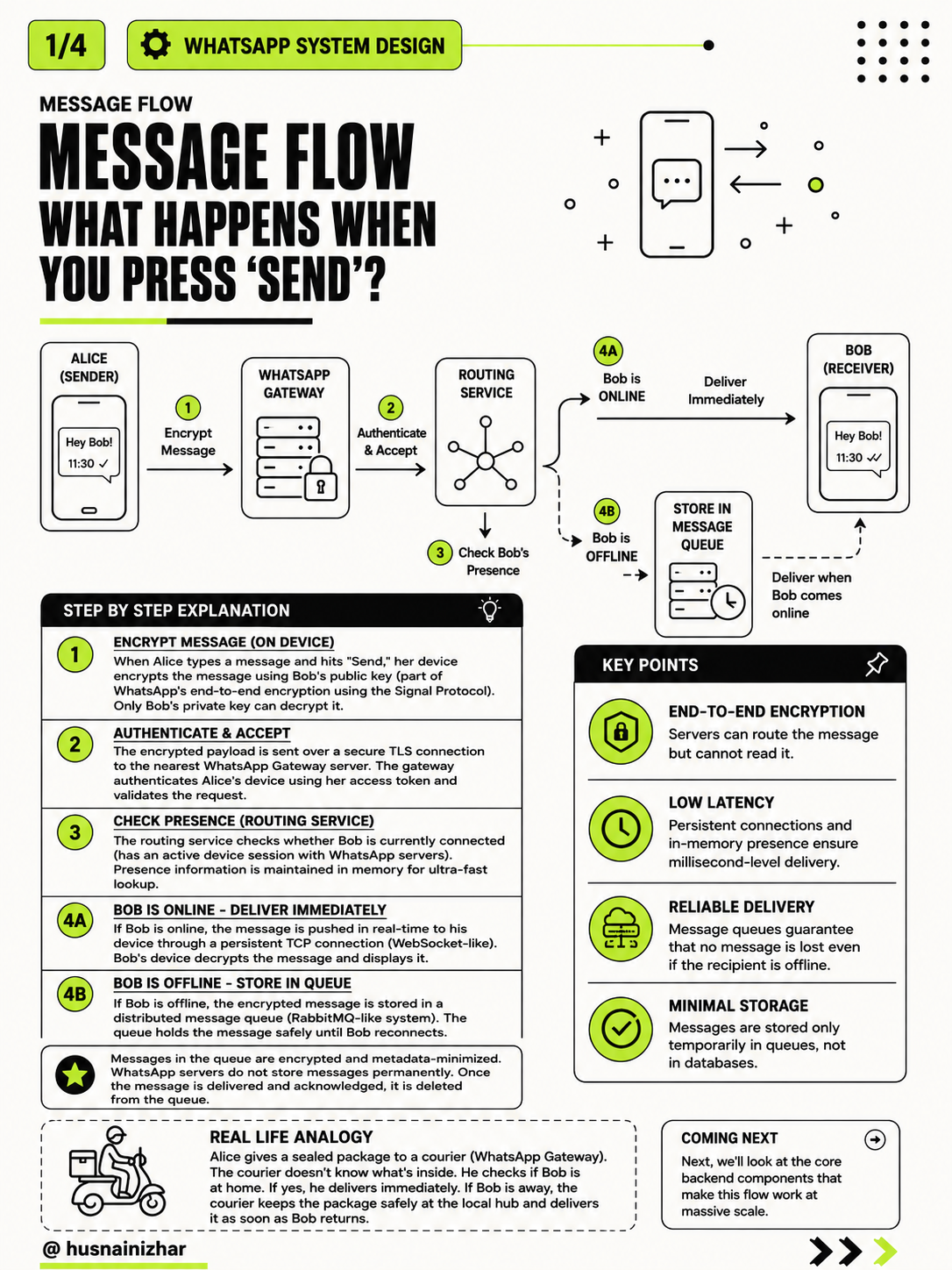
Alice's Phone
     │
     │  Encrypted Message
     ▼
WhatsApp Gateway
     │
     │
     ▼
Routing Service
     │
     │
     ├──── Bob Online ────► Bob's Phone
     │
     │
     └──── Bob Offline ───► Message Queue
                                  │
                                  │ Bob comes online
                                  ▼
                             Bob's Phone
At a high level, the system performs five important operations:
- Encrypt the message on Alice's device.
- Authenticate Alice and accept the encrypted payload.
- Determine where Bob is connected.
- Deliver the message immediately if Bob is online.
- Queue the encrypted message if Bob is offline.
Let's examine each step.
2. Step 1: The Message Is Encrypted on the Device
Alice writes:
Hey Bob!
and presses Send.
The message isn't simply sent to WhatsApp's servers as readable text.
Instead, the client encrypts the message before transmission.
WhatsApp's end-to-end encryption is based on technology from the Signal Protocol.
Conceptually:
Alice's device
      │
      │ "Hey Bob!"
      ▼
Encryption
      │
      ▼
Encrypted Payload
      │
      ▼
WhatsApp Infrastructure
The important idea is that the backend infrastructure can route the encrypted payload without needing to understand the message itself.
This is one of the fundamental architectural characteristics of an end-to-end encrypted messaging system:
The infrastructure transports the message, but the endpoints handle the actual message encryption and decryption.
When Bob receives the message, his device decrypts it and displays the original text.
3. Step 2: The Message Reaches the WhatsApp Gateway
After encryption, Alice's device sends the payload to WhatsApp's backend infrastructure through a secure connection.
A simplified flow looks like:
Alice
  │
  │ TLS + encrypted payload
  ▼
Load Balancer
  │
  ▼
WhatsApp Gateway
The gateway is responsible for accepting incoming connections and requests.
It can perform operations such as:
- Authenticating the client
- Validating the request
- Checking access/session credentials
- Accepting the encrypted payload
- Forwarding the request to the appropriate backend service
The gateway doesn't need to understand the plaintext message.
It primarily needs to establish:
"Is this a legitimate client, and where should this request go?"
4. Step 3: The Routing Service Finds Bob
Now the system has another problem:
Where is Bob?
Bob could be:
- Online on his phone
- Online on a desktop
- Connected through another device
- Temporarily disconnected
- Completely offline
The routing layer needs to determine where Bob's active session exists.
This is where the Presence Service becomes important.
A simplified architecture might look like:
               Routing Service
                     │
                     ▼
              Presence Service
                     │
          ┌──────────┴──────────┐
          │                     │
       ONLINE                 OFFLINE
          │                     │
          ▼                     ▼
   Deliver Immediately     Message Queue
Presence information needs to be extremely fast to access.
For that reason, frequently accessed state can be maintained in memory or a distributed caching system such as Redis.
For example, the system might conceptually maintain:
user_id → active connection/serverSo when a message arrives for Bob, the routing system can quickly determine which server or connection should receive it.
5. What Happens If Bob Is Online?
If Bob currently has an active connection, the system can deliver the encrypted payload immediately.
The simplified flow becomes:
Alice
  │
  ▼
Gateway
  │
  ▼
Routing Service
  │
  ▼
Bob's Active Connection
  │
  ▼
Bob's Device
Messaging systems commonly use long-lived connections rather than repeatedly creating a completely new connection for every message.
This is important for real-time communication.
Instead of constantly asking:
"Do you have a new message?"
the device maintains a connection through which messages can be pushed.
The result is lower latency and less connection overhead.
6. What Happens If Bob Is Offline?
Now consider the opposite situation.
Alice sends a message, but Bob's phone is offline.
The system can't deliver the message immediately.
It needs somewhere to temporarily hold the encrypted message.
This is where a distributed message queue comes in.
Alice
  │
  ▼
Gateway
  │
  ▼
Routing Service
  │
  ▼
Bob Offline
  │
  ▼
Message Queue
  │
  │
  │ Bob reconnects
  ▼
Bob's Device
The queue acts as temporary storage for undelivered messages.
When Bob reconnects, the system can process the queued message and deliver it.
This architecture provides an important reliability property:
A temporary recipient outage doesn't necessarily mean the message is lost.
Queues can also absorb traffic spikes.
If millions of messages arrive simultaneously, backend consumers can process them asynchronously instead of forcing every component to handle the entire traffic spike at once.
7. Core Backend Components
A WhatsApp-like messaging platform isn't one giant server.
It's composed of many specialized services.
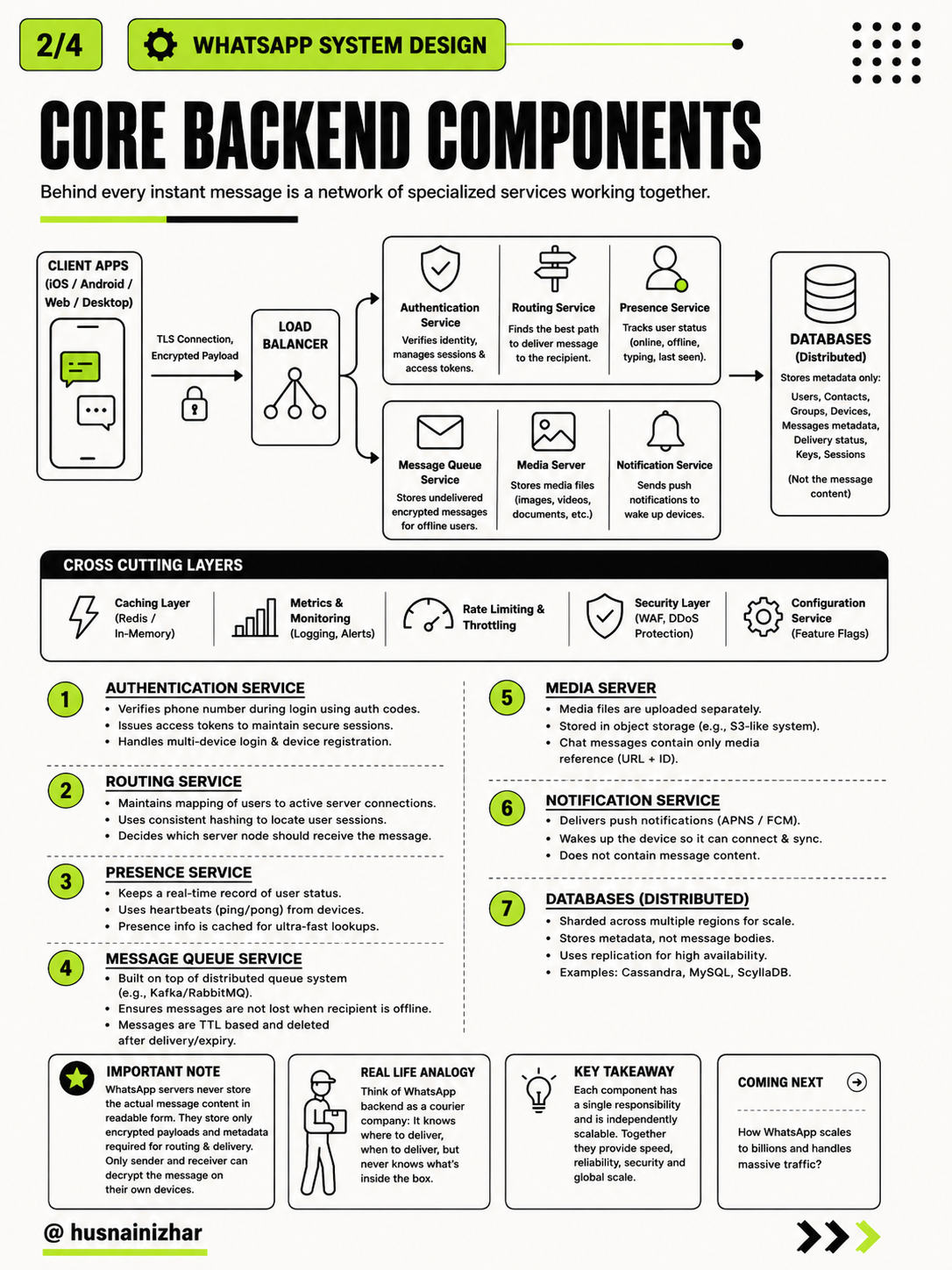
A simplified architecture could look like this:
                   CLIENT APPS
                        │
                        ▼
                 LOAD BALANCER
                        │
        ┌───────────────┼────────────────┐
        │               │                │
        ▼               ▼                ▼
 Authentication      Routing          Presence
 Service             Service          Service
        │               │                │
        └───────────────┼────────────────┘
                        │
             ┌──────────┼──────────┐
             │          │          │
             ▼          ▼          ▼
          Message     Media     Notification
           Queue      Server       Service
             │          │
             └─────┬────┘
                   ▼
            Distributed Data
                Layer
Each service has a specific responsibility.
Authentication Service
The authentication layer is responsible for establishing the identity of a client.
It can handle things such as:
- Login verification
- Session management
- Access tokens
- Device registration
- Multi-device sessions
The key principle is:
Authenticate once, then maintain a secure session.
Routing Service
The routing service determines where messages should go.
It needs to answer questions such as:
- Which server has Bob's active connection?
- Which region should handle this request?
- Which backend node should receive the message?
A routing system needs to be extremely fast because it sits directly in the message-delivery path.
Presence Service
The presence service tracks real-time user state.
Conceptually:
Alice → ONLINE
Bob   → OFFLINE
John  → ONLINE
Sara  → ONLINE
Devices can send periodic heartbeats to indicate that they are still connected.
Because presence information changes frequently and needs fast reads, an in-memory cache is useful.
Message Queue Service
The message queue handles messages that can't immediately be delivered.
A distributed queue can also help absorb traffic spikes.
Conceptually:
Producers
    │
    ▼
┌───────────────┐
│ Message Queue │
└───────────────┘
    │
    ├── Consumer 1
    ├── Consumer 2
    ├── Consumer 3
    └── Consumer N
Systems such as Kafka or RabbitMQ can represent this architectural role, although the exact technology used by a production system can differ.
Media Server
Text messages aren't the only thing users send.
They also send:
- Images
- Videos
- Documents
- Voice messages
- Other media
Large media objects shouldn't necessarily travel through the same path as lightweight text messages.
Instead, media can be uploaded to distributed object storage.
The message itself can contain a reference to the media rather than carrying the entire file through the messaging pipeline.
This separates messaging traffic from large media traffic.
Notification Service
What happens when Bob's application isn't actively running?
A notification service can communicate with mobile push-notification infrastructure such as:
- APNs for Apple devices
- FCM for Android devices
The notification can wake the application or tell the device that synchronization is required.
This helps bridge the gap between an always-on messaging system and mobile devices that may sleep or lose their active connection.
8. The Database Layer
A global messaging platform needs a distributed data layer.
However, not everything needs to be stored in the same database.
Different categories of data have different requirements.
For example:
User Information
Contacts
Groups
Devices
Sessions
Delivery Metadata
Keys
Message Metadata
These can be distributed and replicated across multiple database systems or partitions.
A critical architectural principle is:
Don't put everything into one database and expect it to scale forever.
Instead, data can be partitioned or sharded.
For example:
                User Database
                     │
       ┌─────────────┼─────────────┐
       ▼             ▼             ▼
    Shard 1        Shard 2       Shard N
 Users 1-1M     Users 1M-2M      ...
Sharding distributes the workload across multiple machines.
9. How Do You Scale WhatsApp to Billions of Users?
This is where system design becomes interesting.
A single server cannot handle a global messaging platform.
The architecture needs to scale horizontally.
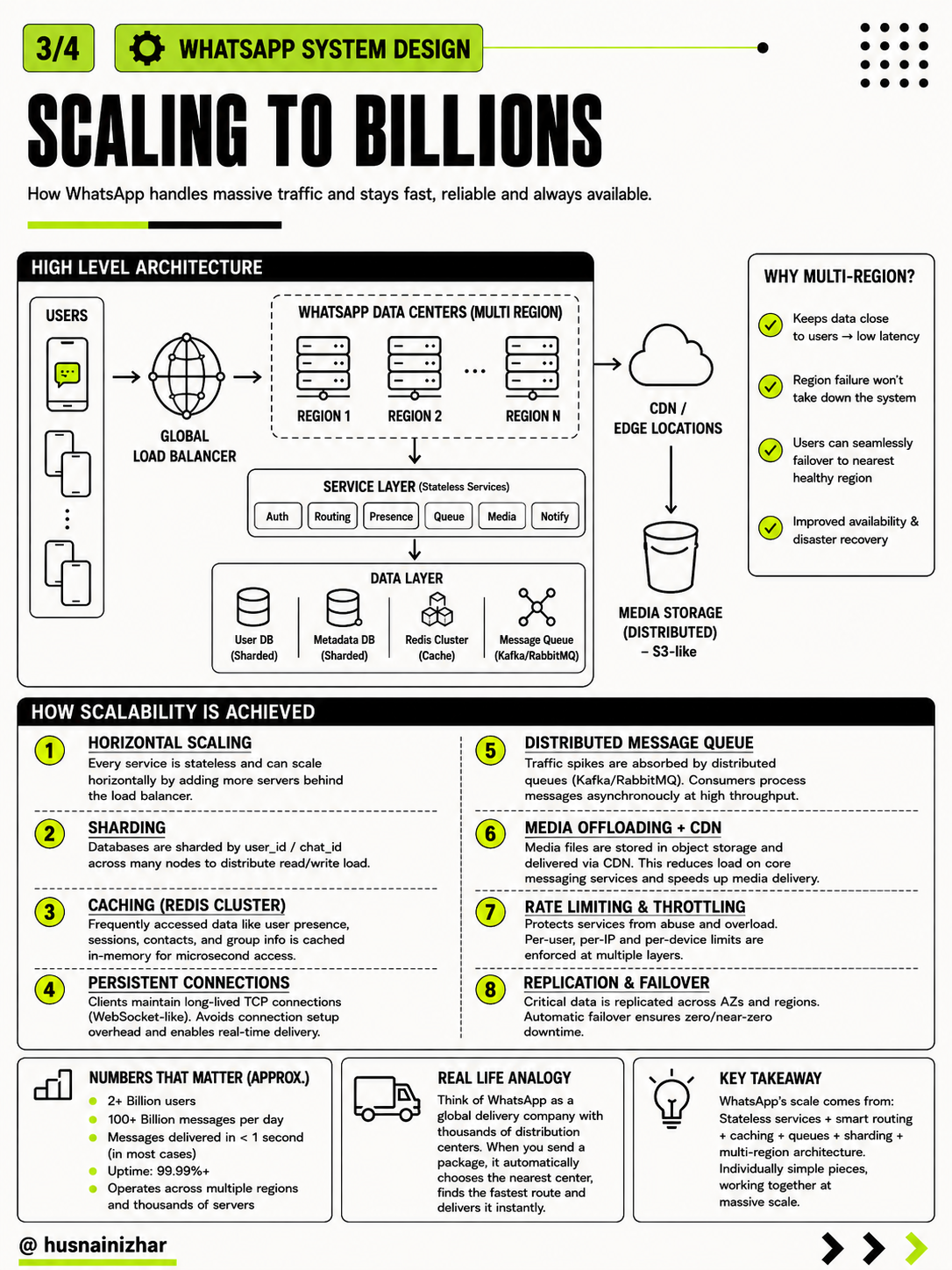
Instead of:
ONE HUGE SERVERwe build:
SERVER  SERVER  SERVER  SERVER
   │       │       │       │
   └───────┴───────┴───────┘
             │
        Load Balancer
If traffic increases, more instances can be added.
This is called horizontal scaling.
10. Stateless Services
A major principle behind scalable architectures is keeping application services as stateless as possible.
Instead of storing important session state inside a specific application server, state can be maintained in dedicated systems.
For example:
Server A ─┐
Server B ─┼──► Redis / Database
Server C ─┤
Server D ─┘
This means another server can handle the next request without depending on the previous server's local memory.
That makes scaling and failover significantly easier.
11. Caching With Redis
Some information is accessed constantly.
Presence is a good example.
Imagine checking a database every time someone wants to know whether a user is online.
At enormous scale, that would create unnecessary database pressure.
Instead:
Application
    │
    ▼
Redis Cache
    │
    ├── Cache Hit → Return immediately
    │
    └── Cache Miss → Query persistent storage
Caching frequently accessed data reduces latency and protects the underlying databases.
12. Database Sharding
Eventually, even a powerful database can become a bottleneck.
Sharding solves this by distributing data across multiple database nodes.
For example:
             User ID
                │
         Hash / Partition
                │
       ┌────────┼────────┐
       ▼        ▼        ▼
     DB-1     DB-2     DB-N
A messaging platform can partition data using identifiers such as:
- user ID
- chat ID
- region
- another partitioning key
The exact strategy depends on the workload and consistency requirements.
13. Multi-Region Architecture
A global messaging platform cannot depend on a single geographic region.
A simplified architecture could look like:
                    USERS
                      │
                      ▼
              GLOBAL LOAD BALANCER
                      │
        ┌─────────────┼─────────────┐
        ▼             ▼             ▼
     REGION 1      REGION 2       REGION N
        │             │             │
     Services      Services       Services
        │             │             │
       Data          Data           Data
Why?
Lower latency
Users can connect to infrastructure geographically closer to them.
Failure isolation
If one region experiences an outage, traffic can potentially be redirected to another healthy region.
Disaster recovery
Replicated infrastructure improves resilience against large-scale failures.
Global availability
The system doesn't depend entirely on one physical location.
14. Persistent Connections
Traditional HTTP request/response communication can introduce connection overhead when used repeatedly for real-time messaging.
A messaging application benefits from maintaining long-lived connections.
Conceptually:
Phone ═══════════════════ Backend
          Persistent
          Connection
The server can then push an incoming message over the existing connection.
This helps achieve the feeling that:
"I pressed Send and the message appeared instantly."
15. Handling Traffic Spikes With Queues
Imagine a major event where millions of users suddenly start sending messages.
If every request must be processed synchronously by every downstream service, the system could become overloaded.
A distributed queue introduces buffering.
Incoming Traffic
      │
      ▼
┌──────────────┐
│ Message Queue│
└──────────────┘
      │
      ▼
Consumers
Producers can place work into the queue while consumers process it at a controlled rate.
This gives the system a buffer between traffic entering the platform and work being processed.
16. Reliability: What If Something Fails?
At global scale, failures aren't hypothetical.
Servers fail.
Networks fail.
Devices disconnect.
Regions can experience outages.
The architecture therefore needs multiple layers of reliability.
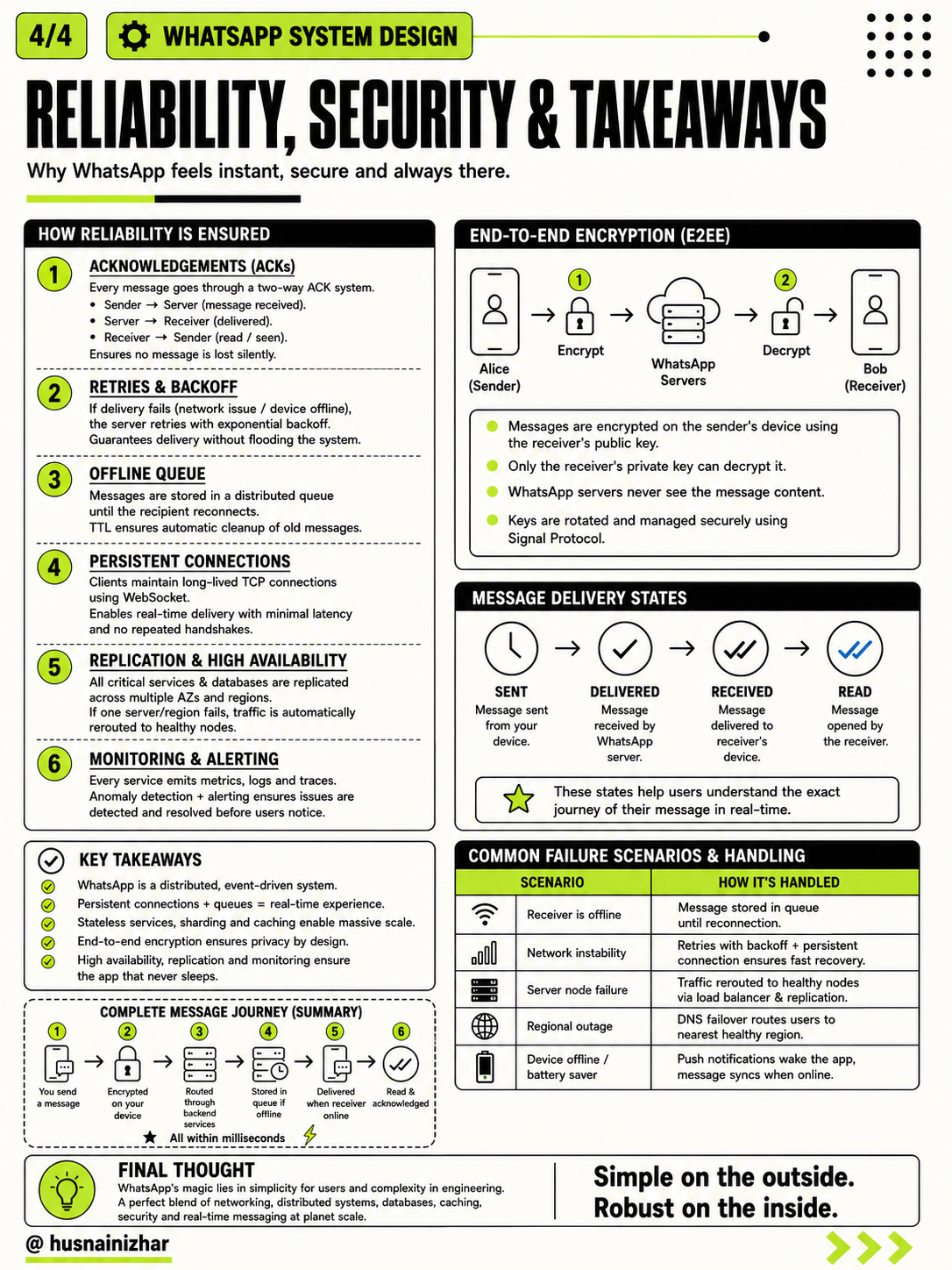
Acknowledgements
A message can move through multiple states.
Conceptually:
SENT
  ↓
DELIVERED
  ↓
RECEIVED
  ↓
READ
Acknowledgements provide feedback about where the message is in its journey.
Retries and Backoff
If a delivery attempt fails, blindly retrying thousands of times per second would make the problem worse.
Instead, systems can use retry policies with backoff.
For example:
Attempt 1 → Fail
     ↓
Wait
     ↓
Attempt 2 → Fail
     ↓
Wait longer
     ↓
Attempt 3
This reduces unnecessary load during temporary failures.
Offline Queues
If Bob is offline:
Message
   ↓
Queue
   ↓
Bob reconnects
   ↓
Message delivered
Messages can have expiration policies so that stale data doesn't remain in queues indefinitely.
Replication
Critical data and services can be replicated across availability zones and regions.
If one node fails:
Node A ❌
   │
   ▼
Node B ✅
Traffic can be redirected to healthy infrastructure.
17. End-to-End Encryption
Security is another fundamental part of the architecture.
The conceptual journey is:
Alice's Device
      │
      ▼
  Encrypt
      │
      ▼
WhatsApp Infrastructure
      │
      ▼
   Deliver
      │
      ▼
  Decrypt
      │
      ▼
Bob's Device
The important distinction is that the backend infrastructure is primarily responsible for transporting and routing the encrypted payload.
The endpoints handle encryption and decryption.
This provides privacy by design while allowing the infrastructure to perform its routing and delivery responsibilities.
18. Why Doesn't WhatsApp Simply Store Every Message in a Database?
Because a messaging system has fundamentally different storage requirements from a traditional CRUD application.
The architecture can separate:
Message content
from
Message metadata
For example, the system may need information related to:
- Sender
- Recipient
- Delivery state
- Device/session information
- Routing information
- Timestamps
- Other operational metadata
Meanwhile, encrypted message payloads can be handled through the message-delivery pipeline and temporary storage mechanisms.
This separation helps with performance, scalability, and privacy.
19. What Happens During a Regional Failure?
Imagine Region 1 becomes unavailable.
A resilient global architecture can detect the failure and redirect traffic toward healthy infrastructure.
             Global Traffic
                  │
        ┌─────────┼─────────┐
        ▼         ▼         ▼
     Region 1  Region 2  Region 3
        ❌         ✅         ✅
                  ▲
                  │
              Failover
Health checks, load balancing, DNS-based routing, replication, and regional failover can work together to keep the service available.
The exact implementation of a production system can be much more sophisticated, but the principle remains the same:
Don't allow one failed component to become one failed system.
20. Putting Everything Together
Now let's combine all the pieces.

A simplified WhatsApp-like architecture looks like this:
                         USERS
                           │
                           ▼
                  GLOBAL LOAD BALANCER
                           │
            ┌──────────────┼──────────────┐
            ▼              ▼              ▼
         REGION 1       REGION 2       REGION N
            │              │              │
            ▼              ▼              ▼
       ┌─────────────────────────────────────┐
       │          SERVICE LAYER               │
       │ Auth | Routing | Presence | Queue   │
       │ Media | Notifications               │
       └─────────────────────────────────────┘
                         │
             ┌───────────┼───────────┐
             ▼           ▼           ▼
          Redis      Databases     Queues
             │           │           │
             └───────────┼───────────┘
                         ▼
                  Media Storage
                         │
                         ▼
                        CDN
And the individual message journey is:
1. Alice types message
          ↓
2. Message encrypted on device
          ↓
3. Secure connection to backend
          ↓
4. Gateway authenticates request
          ↓
5. Routing service finds Bob
          ↓
6. Presence service checks status
          ↓
     ┌────┴────┐
     │         │
 ONLINE      OFFLINE
     │         │
     ▼         ▼
 Deliver     Queue
     │         │
     │      Bob reconnects
     │         │
     └────┬────┘
          ▼
      Bob's Device
          ↓
       Decrypt
          ↓
        Display
          ↓
    Acknowledgement
All of this happens while the user experiences a simple action:
"Send."
21. The Most Important System Design Lessons
WhatsApp is a great example of several fundamental distributed-system principles.
1. Keep services independently scalable
Authentication, routing, presence, queues, media, and notifications have different workloads.
Separating them allows each service to scale independently.
2. Use caching for frequently accessed state
Presence and session information need extremely fast lookups.
3. Use queues for reliability and traffic absorption
Queues allow asynchronous processing and help handle temporary spikes.
4. Shard large datasets
A single database eventually becomes a bottleneck at massive scale.
5. Use persistent connections for real-time communication
Long-lived connections reduce repeated connection overhead and enable fast server-to-client delivery.
6. Offload media
Large files shouldn't unnecessarily overload the core messaging pipeline.
Object storage and CDNs are better suited for large media distribution.
7. Design for failure
Servers will fail.
Networks will fail.
Regions will fail.
A distributed system needs replication, retries, health checks, failover, and monitoring from the beginning.
8. Security must be part of the architecture
Encryption isn't something that should simply be added at the end.
For an end-to-end encrypted messaging system, security fundamentally shapes the architecture.
Final Thoughts
The magic of WhatsApp isn't that sending a message is simple.
It's that the complexity is hidden from the user.
When Alice sends:
"Hey Bob!"
she doesn't think about:
- load balancers
- routing
- presence
- persistent connections
- queues
- sharding
- caching
- replication
- multi-region infrastructure
- failover
- encryption
- push notifications
- distributed databases
She simply sees:
✓✓
That's the essence of great system design:
Simple on the outside. Robust on the inside.
A WhatsApp-like messaging system demonstrates how networking, distributed systems, databases, caching, queues, security, and reliability engineering come together to create a real-time application that can operate at global scale.