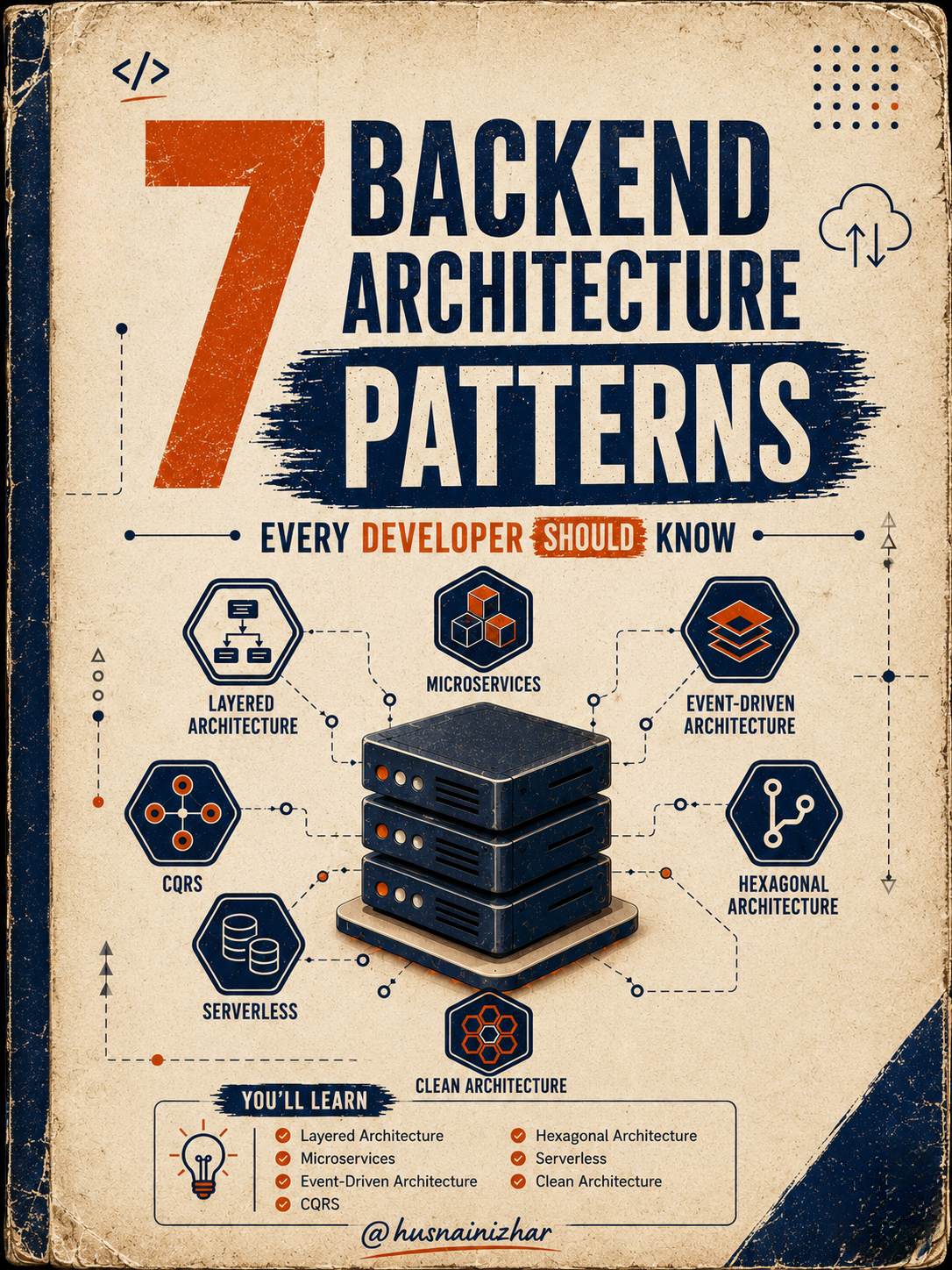
7 Backend Architecture Patterns Every Developer Should Know
Most backend problems aren't really bugs — they're architecture decisions catching up with you. A slow deploy pipeline, a codebase nobody wants to touch, a "quick fix" that breaks three other things — these usually trace back to a pattern that no longer fits the system's size or purpose.
The good news: you don't need to master all of them at once. You just need to know they exist, what problem each one solves, and where each one starts to hurt. Here are 7 backend architecture patterns worth understanding before your next project.
1. Monolithic Architecture
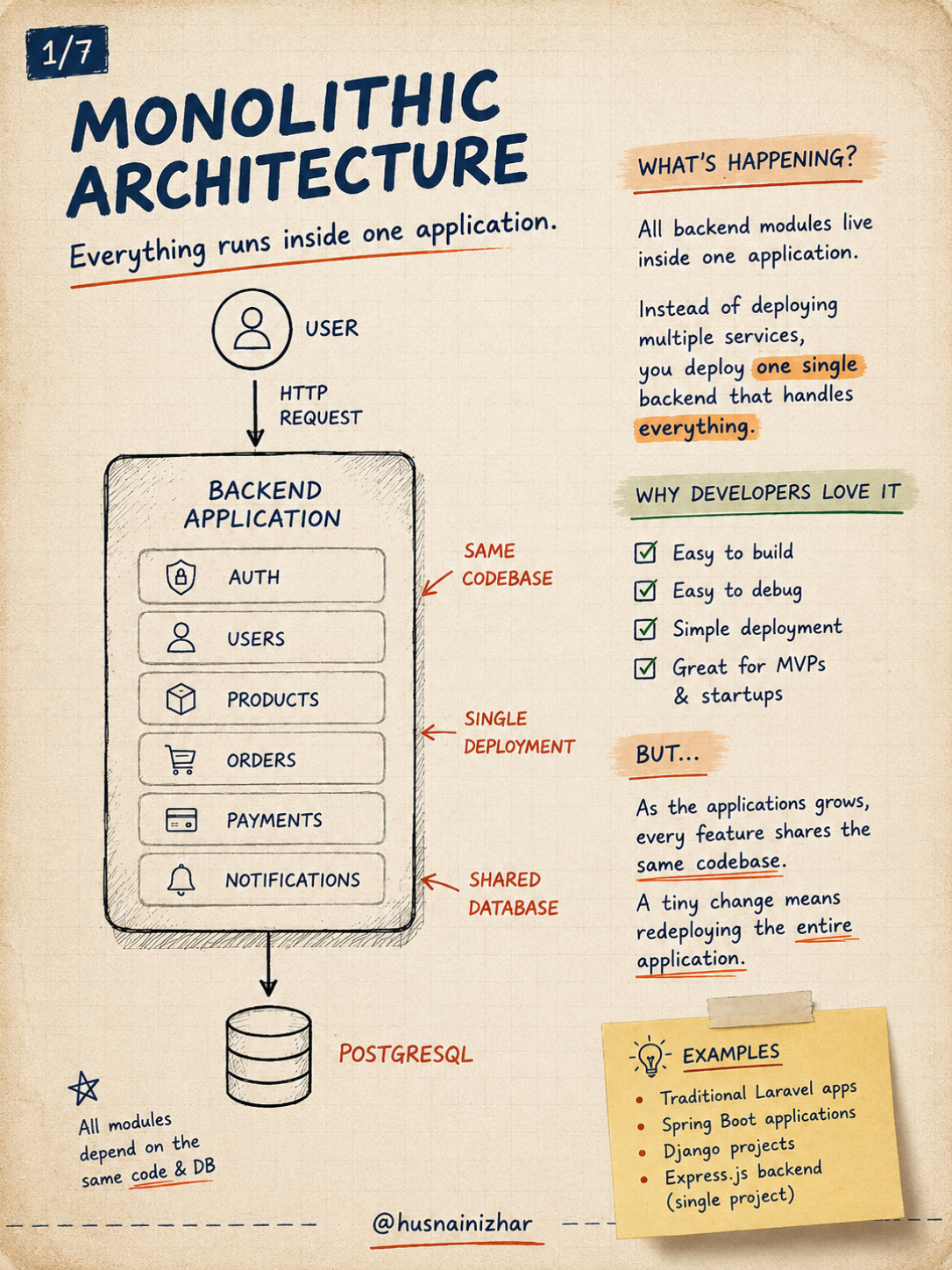
The idea: Everything — auth, users, products, orders, payments, notifications — lives inside one application, sharing one codebase and one database.
Why developers love it:
- Easy to build and debug
- Simple deployment — one unit to ship
- Great for MVPs and early-stage startups
The catch: As the app grows, every feature shares the same codebase and database. A tiny change often means redeploying the entire application, and the whole system becomes harder to reason about.
Seen in: Traditional Laravel apps, Spring Boot applications, Django projects, single-project Express.js backends.
2. Microservices Architecture
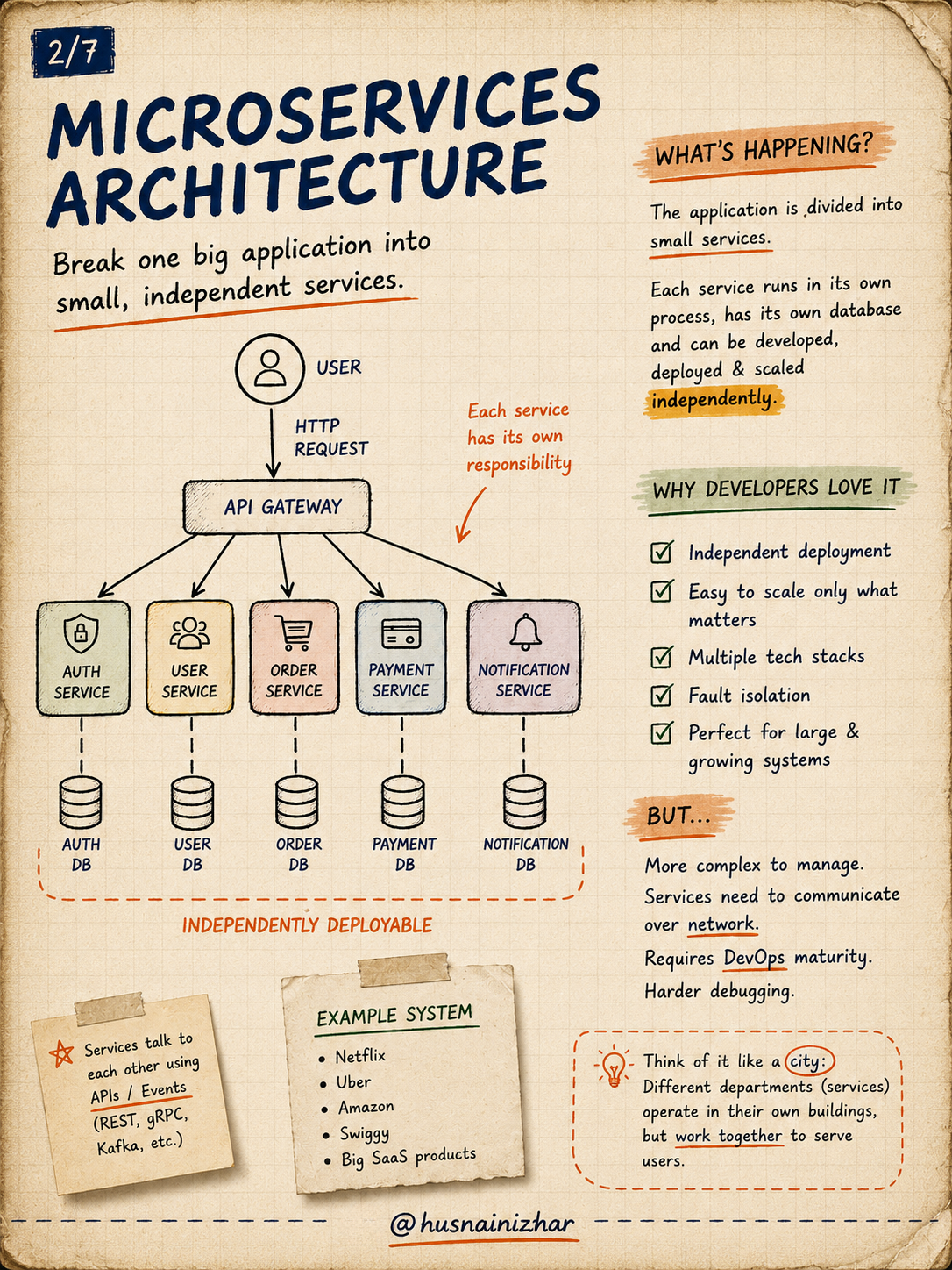
The idea: Break one large application into small, independent services — each with its own database, its own deployment lifecycle, and a single clear responsibility. Requests come in through an API Gateway and get routed to the right service.
Why developers love it:
- Independent deployment per service
- Scale only what actually needs scaling
- Teams can use different tech stacks
- Fault isolation — one service failing doesn't take down everything
The catch: More moving parts means more complexity. Services need to talk to each other over the network (REST, gRPC, events), which demands real DevOps maturity and makes debugging harder.
Think of it like: A city — different departments (services) operate out of their own buildings but work together to serve the same population.
Seen in: Netflix, Uber, Amazon, and most large-scale SaaS products.
3. Event-Driven Architecture
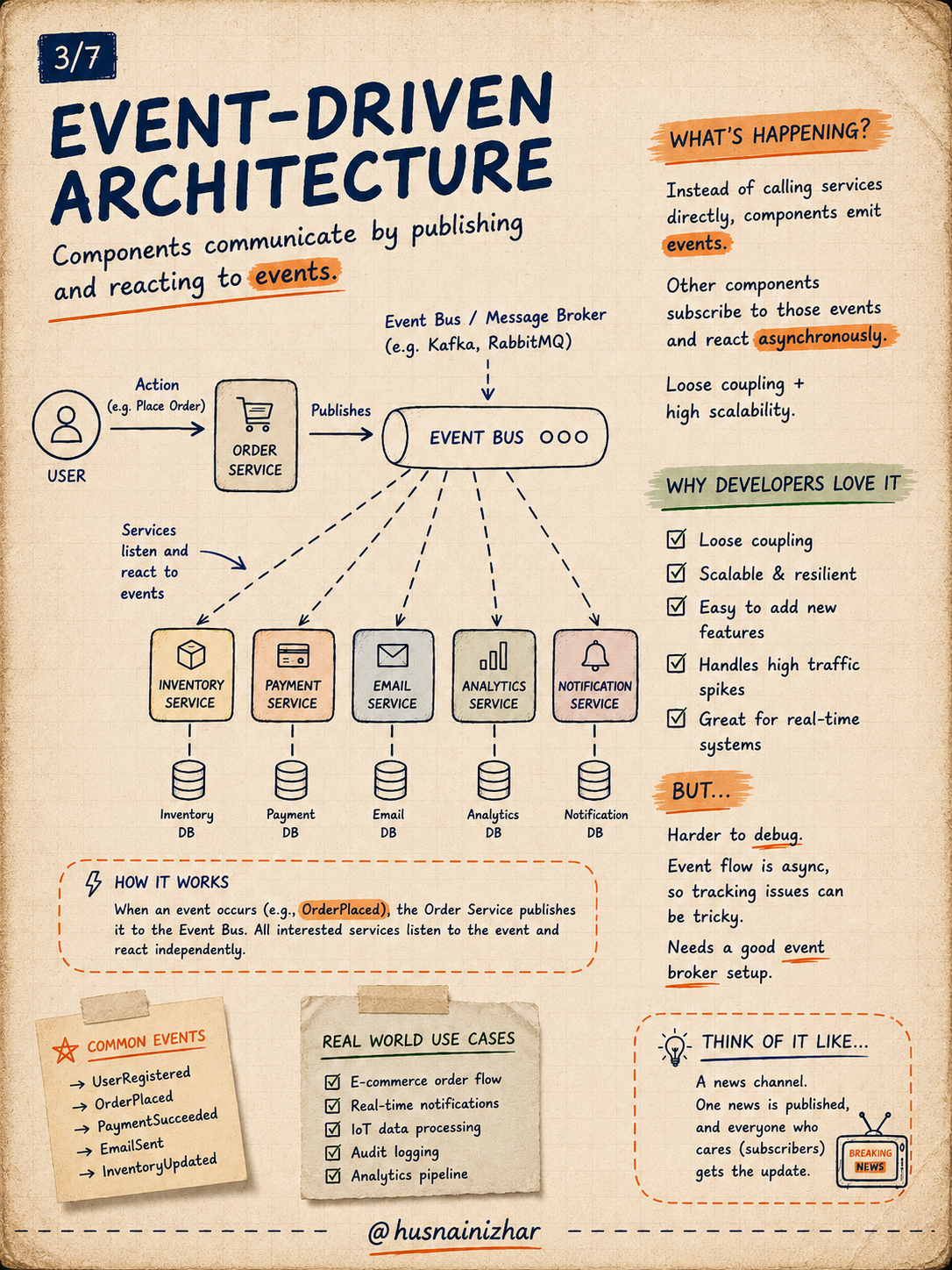
The idea: Instead of services calling each other directly, components publish events to an event bus (like Kafka or RabbitMQ). Other services subscribe and react asynchronously.
Why developers love it:
- Loose coupling between services
- Highly scalable and resilient
- New features can be added without touching existing services
- Handles traffic spikes gracefully
The catch: Async flows are genuinely harder to trace. When something breaks, following the event chain across services takes more effort — and you need a properly configured event broker to make it work well.
Think of it like: A news channel — one story is published, and every subscriber who cares picks it up independently.
Common events: UserRegistered, OrderPlaced, PaymentSucceeded, EmailSent, InventoryUpdated
Seen in: E-commerce order flows, real-time notification systems, IoT data pipelines, audit logging, analytics pipelines.
4. Serverless Architecture
The idea: You write functions. The cloud provider runs them only when triggered — by an HTTP request, a file upload, a database change, or a schedule — and handles all the scaling, patching, and infrastructure.
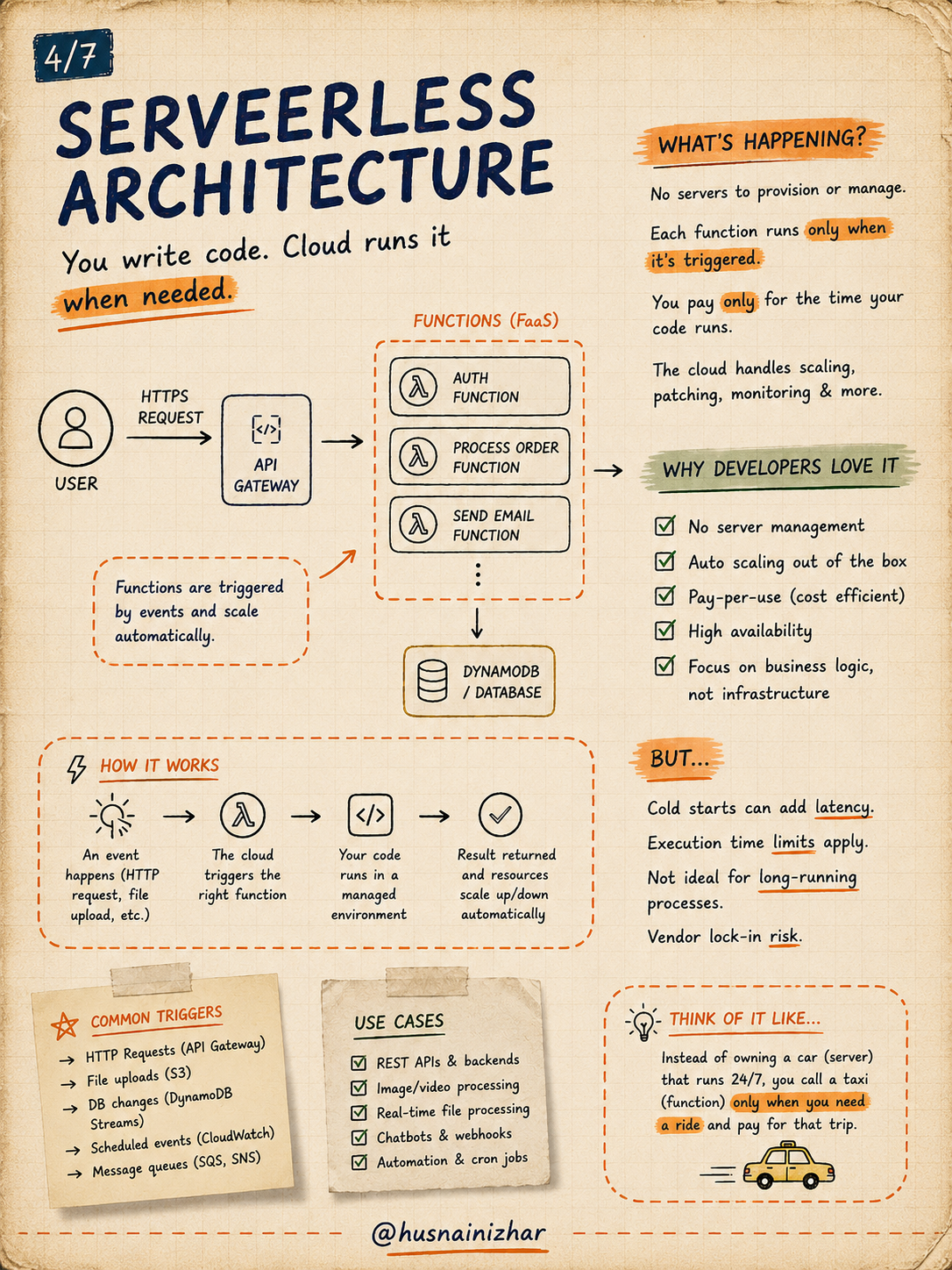
Why developers love it:
- Zero server management
- Automatic scaling out of the box
- Pay only for the compute time you actually use
- Lets teams focus on business logic instead of infrastructure
The catch: Cold starts can add latency, execution time limits apply, and it's not built for long-running processes. There's also a real risk of vendor lock-in.
Think of it like: Calling a taxi instead of owning a car. You don't maintain the vehicle — you just pay for the ride, only when you need one.
Seen in: REST APIs and lightweight backends, image/video processing, chatbots and webhooks, scheduled automation jobs.
5. Layered Architecture (N-Tier)
The idea: Code is organized into distinct layers — Presentation, Application, Domain/Business, Data Access, and Database — where each layer has one job and only talks to the layer directly next to it.
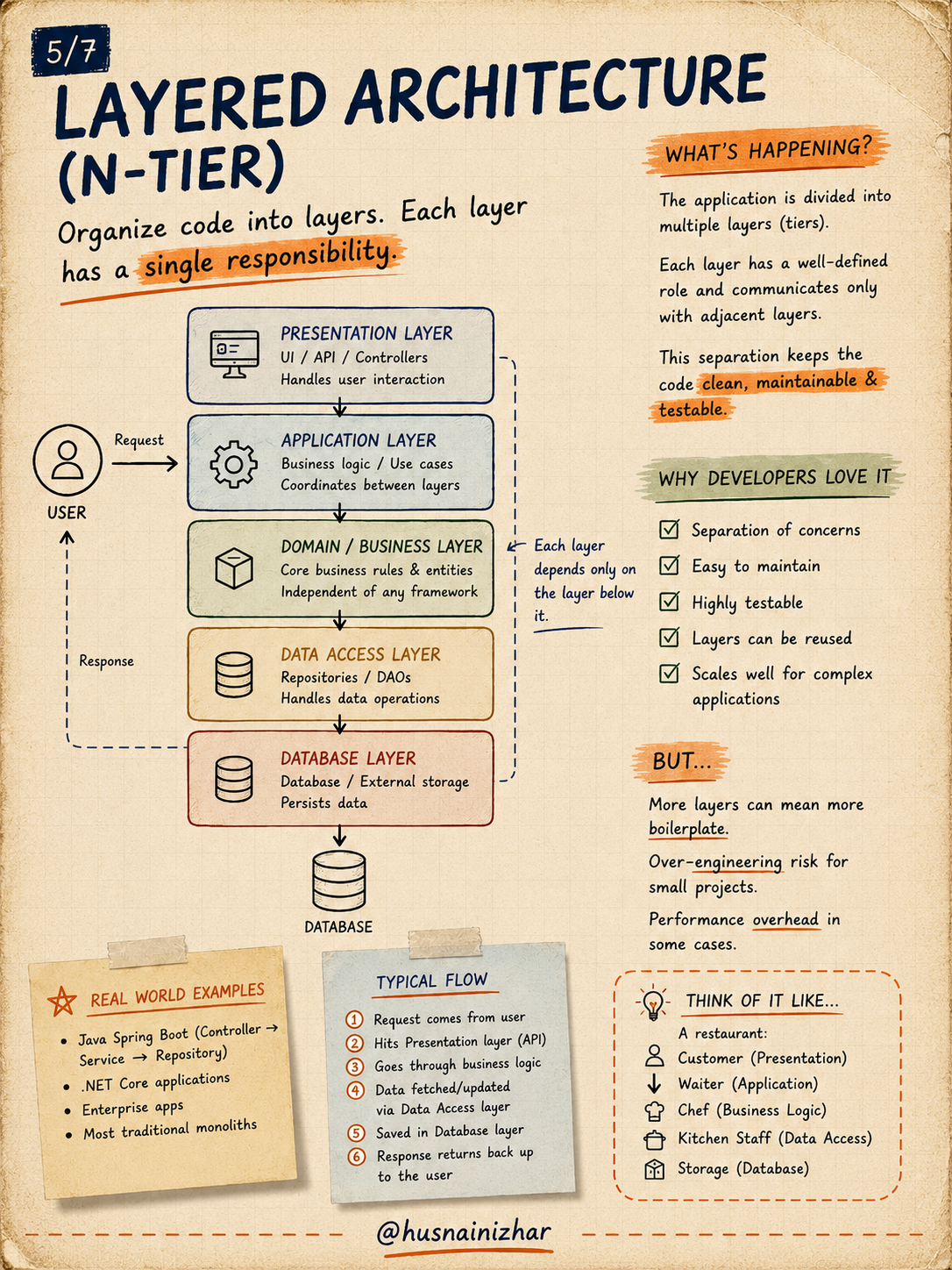
Why developers love it:
- Clear separation of concerns
- Easy to maintain and highly testable
- Layers can be reused across features
- Scales well for complex, long-lived applications
The catch: More layers can mean more boilerplate, and for small projects, it can be overkill relative to the actual complexity of the problem.
Think of it like: A restaurant — the customer (Presentation), the waiter (Application), the chef (Business Logic), kitchen staff (Data Access), and storage (Database) each play a distinct role in the same flow.
Seen in: Java Spring Boot (Controller → Service → Repository), .NET Core applications, most enterprise and traditional monolithic systems.
6. Hexagonal Architecture (Ports & Adapters)
The idea: Core business logic sits isolated in the center, completely unaware of databases, frameworks, or APIs. Everything external — REST APIs, CLIs, mobile apps, databases, caches, third-party services — connects through "ports" as interchangeable adapters.
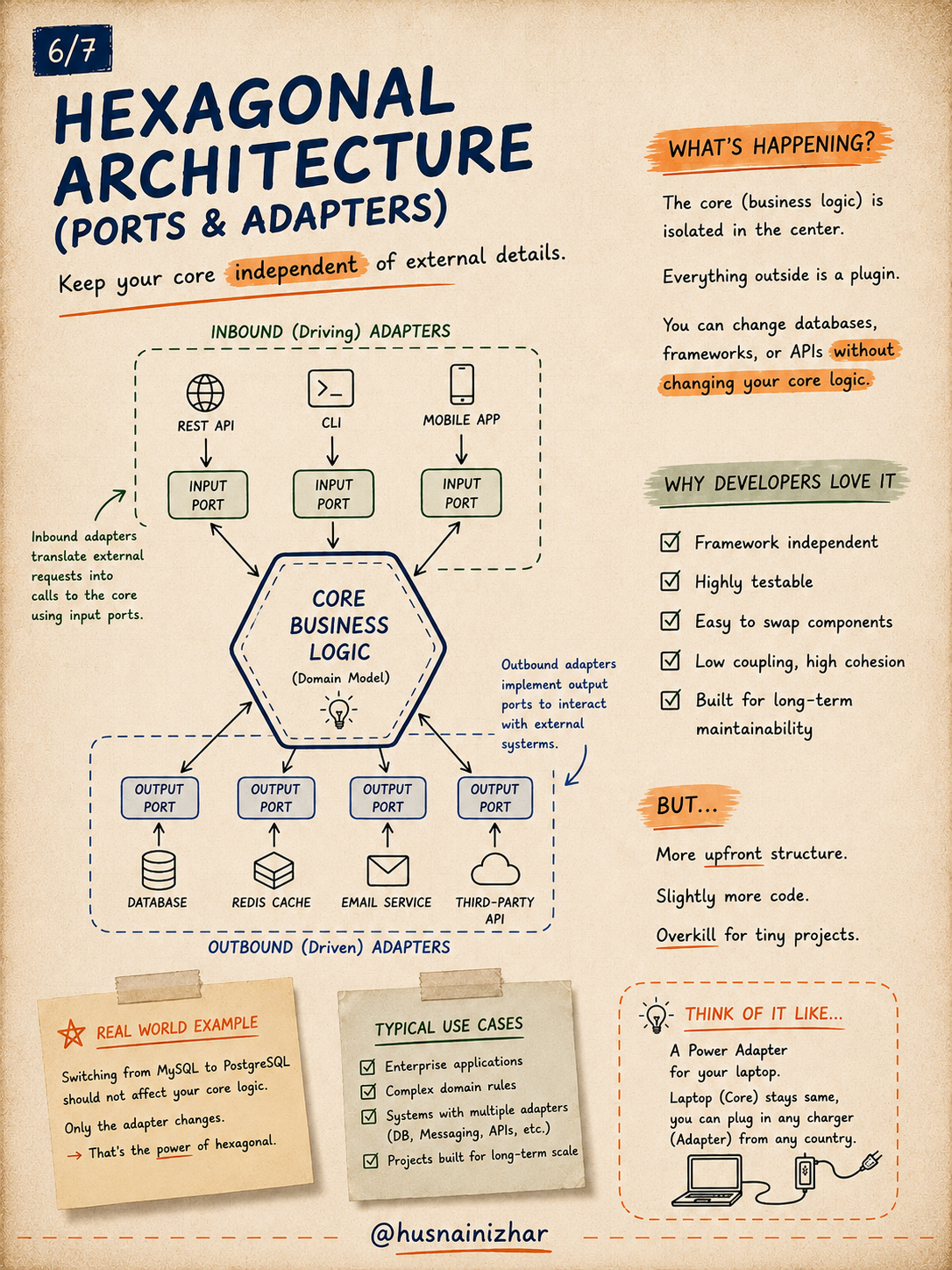
Why developers love it:
- Framework-independent core logic
- Highly testable in isolation
- Easy to swap components (e.g., change databases without touching business logic)
- Built for long-term maintainability
The catch: It demands more upfront structure and a bit more code — genuinely overkill for a small, short-lived project.
Think of it like: A power adapter for your laptop. The laptop (your core logic) stays the same no matter which charger (external system) you plug in from any country.
Seen in: Enterprise applications, systems with complex domain rules, projects with multiple integration points built for long-term scale.
7. CQRS (Command Query Responsibility Segregation)
The idea: Split the system into two sides — a Command side that handles writes (create/update/delete) and a Query side that handles reads — each with its own optimized model and, often, its own database.
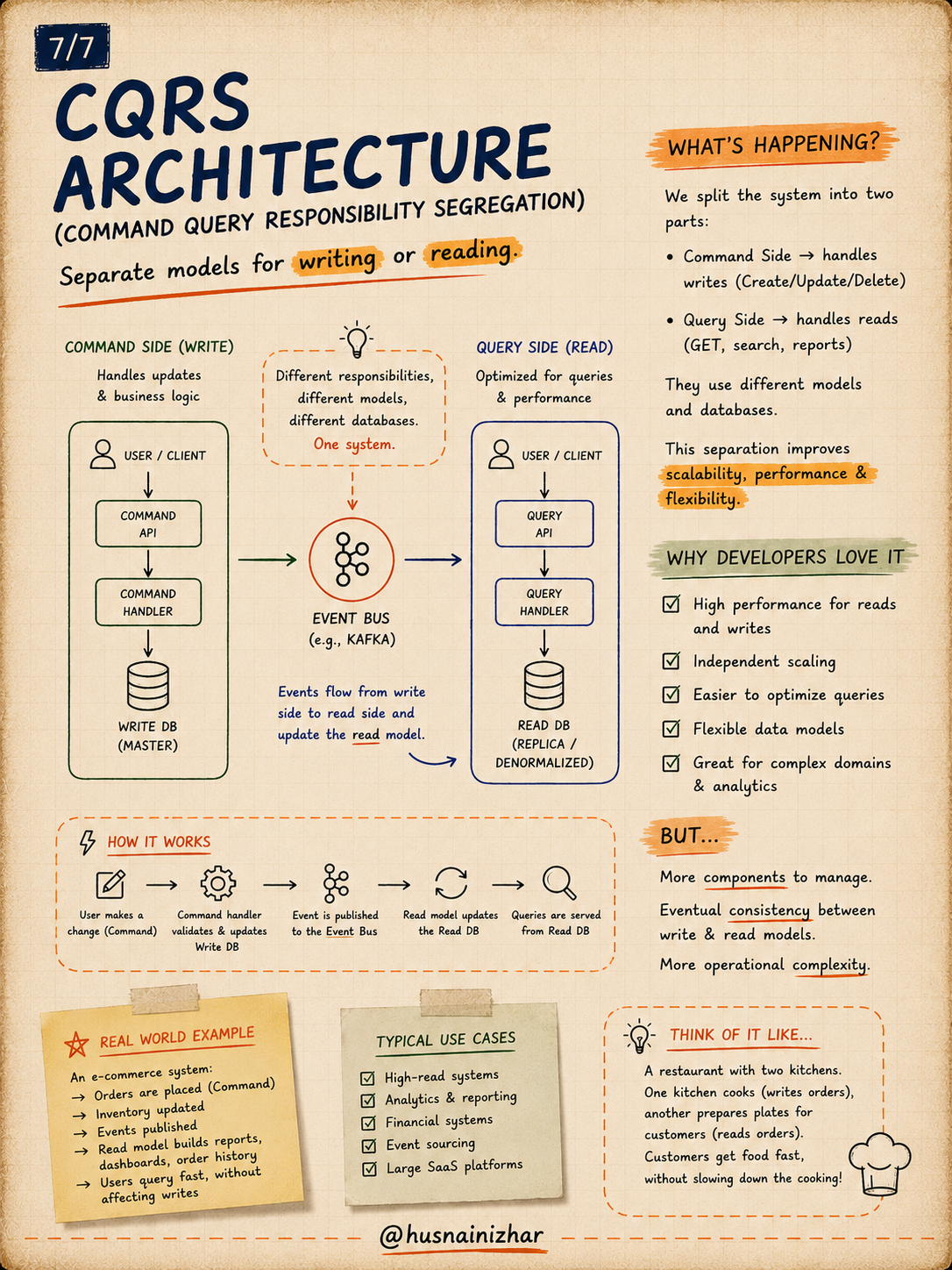
Why developers love it:
- High performance for both reads and writes independently
- Each side scales on its own
- Read queries can be heavily optimized without touching write logic
- Great fit for complex domains and analytics-heavy systems
The catch: More components to manage, and the read and write models are only eventually consistent with each other — which adds real operational complexity.
Think of it like: A restaurant with two kitchens — one cooks fresh orders, the other prepares plates for pickup. Customers get served fast without either side slowing the other down.
Seen in: High-read systems, financial platforms, analytics and reporting tools, event-sourced systems, large-scale SaaS products.
So, Which One Should You Use?
None of these patterns is objectively "the best." Each one trades simplicity for scalability, or structure for speed, in a different way. The real question is:
What problem does my system actually have right now?
- Building an MVP fast? Start with a monolith.
- Scaling a large team across many features? Consider microservices.
- Need loose coupling and real-time reactivity? Event-driven fits well.
- Unpredictable, spiky traffic with minimal ops overhead? Serverless.
- Want clean, maintainable structure without overengineering? Layered architecture.
- Need your core logic to outlive any framework or database choice? Hexagonal.
- Read and write loads are wildly different in scale? CQRS.

Understanding these patterns isn't about memorizing diagrams — it's about recognizing which trade-offs you're willing to accept, and when. That's the difference between an architecture that ages well and one you'll be rewriting in eighteen months.
Which pattern are you using in your current project — and which one have you been avoiding? Let me know in the comments.