Agentic Memory Systems: How to Give AI Agents Real Memory Beyond the Context Window
If you've spent any time building with large language models, you've probably run into the same wall: your AI agent works beautifully during a conversation, then completely forgets who you are the moment a new session starts.
Ask it your name again tomorrow, and it has no idea.
The instinct is to reach for a bigger context window. More tokens, more room, problem solved — right? Not quite. A context window is not memory. It's a temporary workspace that empties out the second the session ends. If you want an AI agent that actually remembers you — your name, your preferences, your past conversations — you need something fundamentally different: an agentic memory system.
This post breaks down what that means, the different types of memory an agent can have, and how to actually build one.
Short-Term Memory vs. Long-Term Memory
Every conversation with an LLM starts with short-term memory — the active "sliding window" of the current thread. It holds everything said so far in the conversation, but it's temporary by nature. Once the session ends (or the window fills up and old messages get pushed out), that context is gone for good.
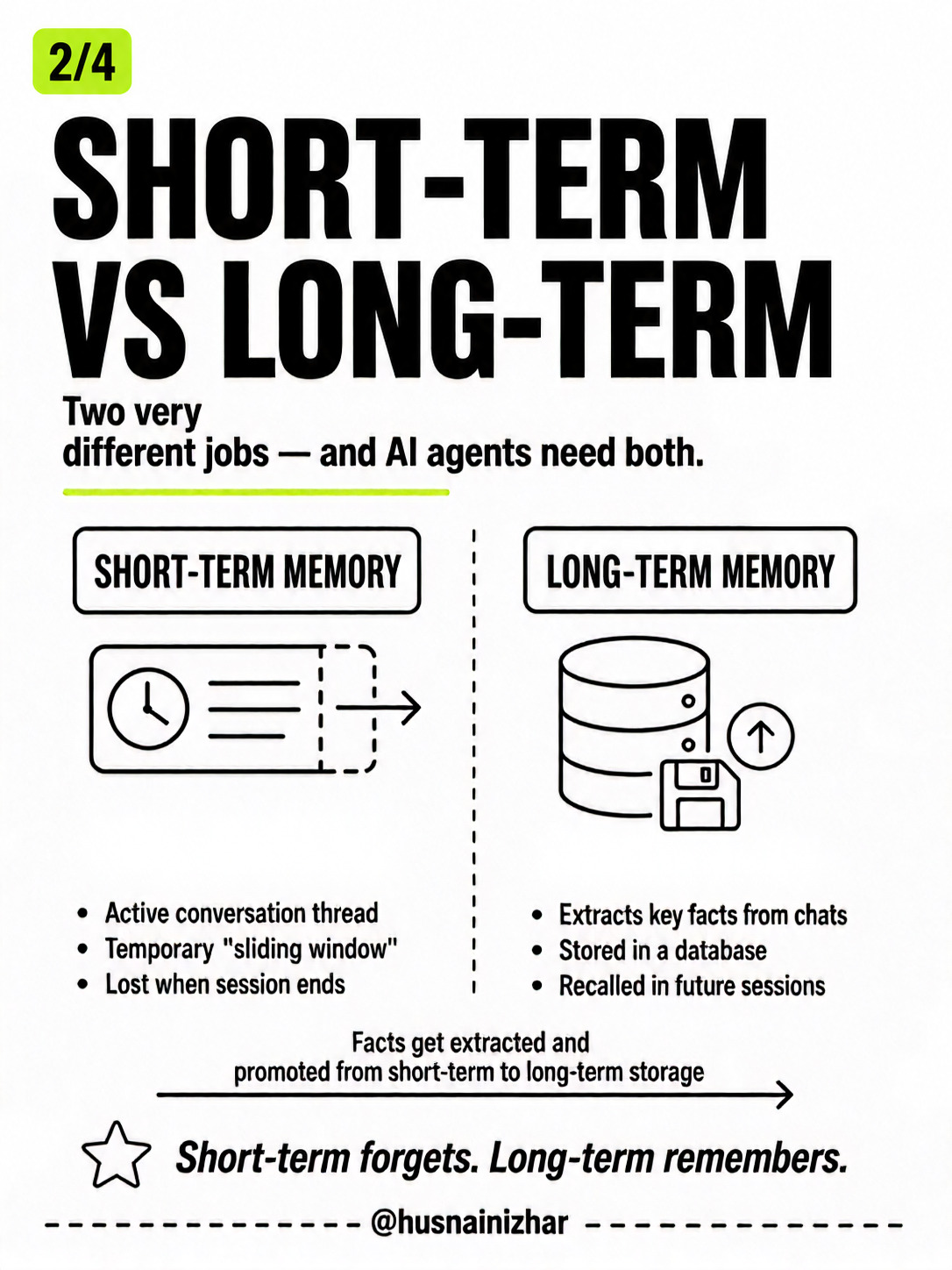
Long-term memory solves this by extracting important facts from a conversation and storing them somewhere persistent — a database. Instead of relying on the model to "remember" everything in its context, the system pulls out key details (a user's name, their preferences, a past decision they made) and saves them for later. When a new session starts, the agent can look up what it knows about you before responding.
This is the core shift: instead of one long, ever-growing context window, you get a system that actively decides what's worth remembering and retrieves it only when needed.
The Four Types of Long-Term Memory
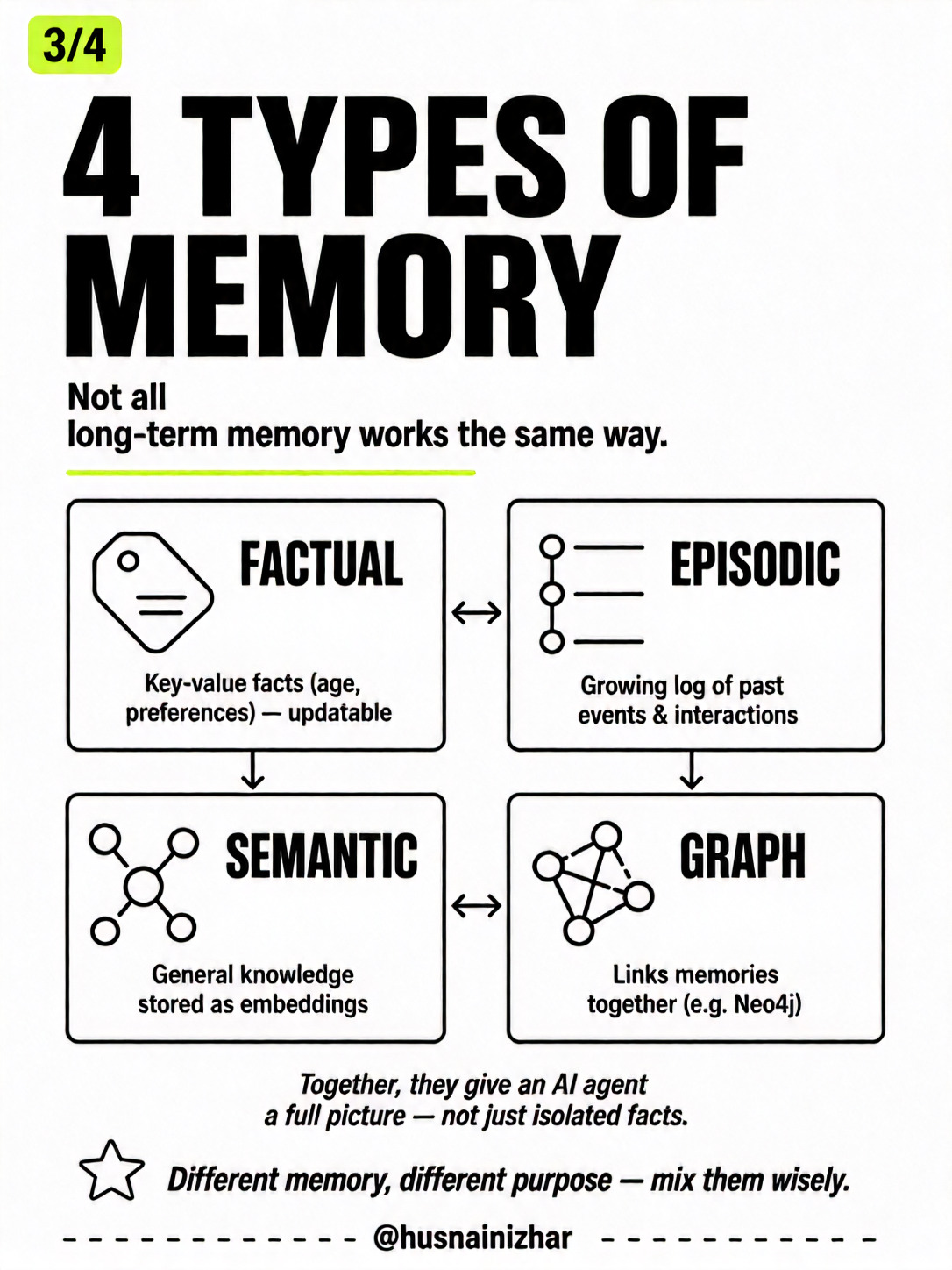
Not all long-term memory works the same way. Depending on what you're building, you'll likely need a combination of these four types:
1. Factual Memory
Simple key-value pairs about the user — age, preferences, role, timezone, whatever matters for your use case. These values can be overwritten as new information comes in, so the agent always has the most current facts on hand.
2. Episodic Memory
A growing log of past interactions and specific events. Rather than a single fact, this is a history — a record of what happened and when, useful for recalling context like "last time we talked, you mentioned you were switching jobs."
3. Semantic Memory
General knowledge, typically stored as vector embeddings. This isn't about a single user's facts — it's broader, conceptual knowledge that the agent can search against for relevant context.
4. Graph Memory
A graph-based approach (tools like Neo4j are common here) that links memories together. This is what lets an agent connect disparate pieces of information — for example, associating a specific object or event with a past incident, rather than treating every memory as an isolated fact.
Most production-grade memory systems combine several of these. Factual memory for quick lookups, episodic memory for history, semantic memory for broader recall, and graph memory to tie it all together.
Building It: From Theory to a Working System
Here's what a practical implementation actually looks like:
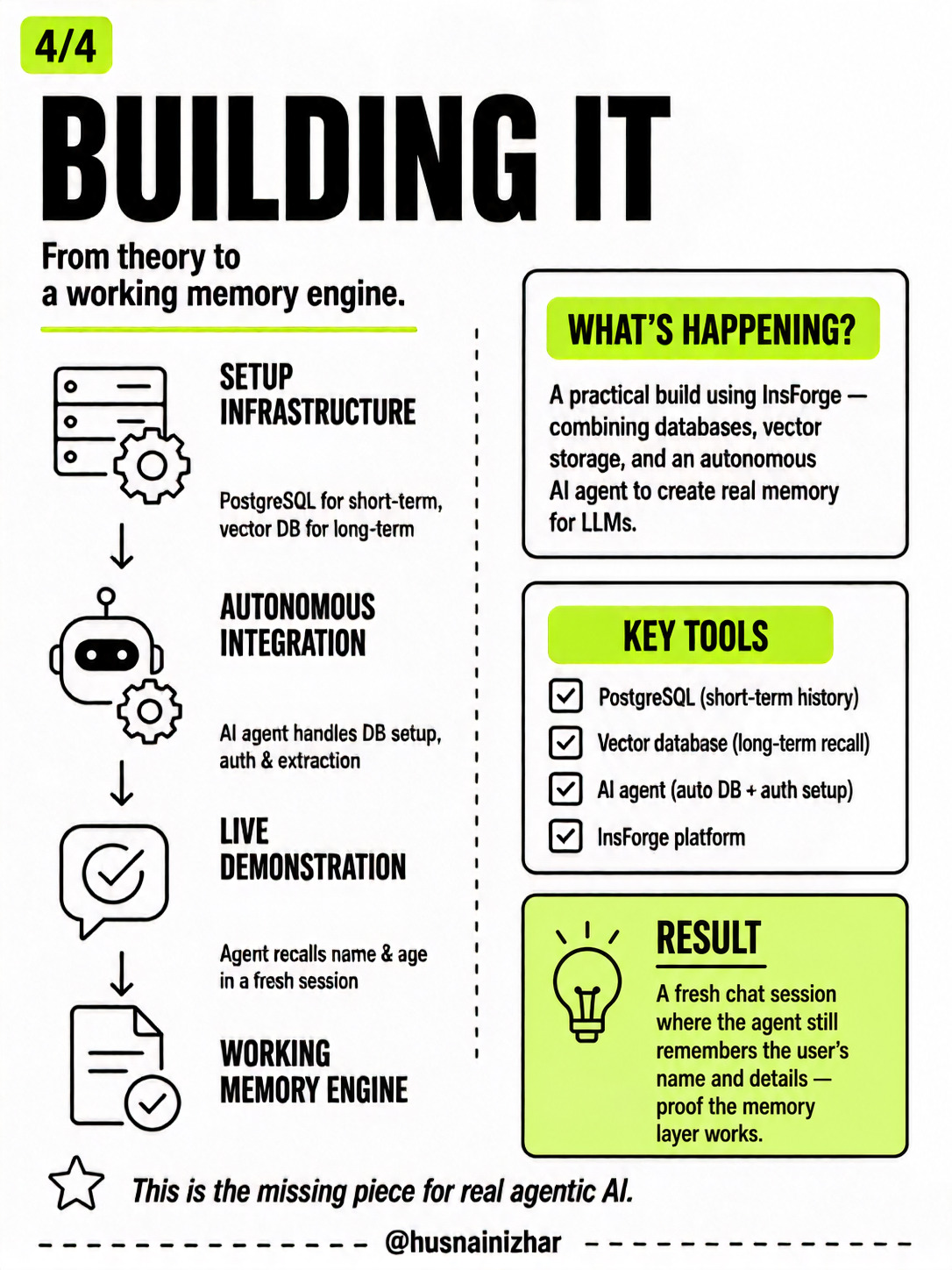
1. Set up the infrastructure. Use a relational database like PostgreSQL to handle short-term conversation history, paired with a vector database for long-term, semantically searchable memory.
2. Let an AI agent handle the integration. Instead of manually wiring up database creation, authentication, and memory extraction logic, an AI agent can autonomously handle this setup — reading the schema it needs, creating tables, and extracting facts from conversations as they happen.
3. Test it with a fresh session. The real proof of a working memory system isn't in the same conversation — it's in a brand-new one. Start a fresh chat, and if the agent can still recall your name, your age, or details from a previous session, the memory layer is doing its job.
Platforms like InsForge are making this kind of setup increasingly accessible, letting developers stand up a working memory engine without hand-building every piece of the pipeline from scratch.
Why This Matters
As AI agents move from single-turn chatbots to systems that operate over days, weeks, or ongoing projects, memory stops being a nice-to-have and becomes a core requirement. An agent that forgets everything between sessions can't build a relationship with a user, can't track long-running tasks, and can't get smarter about how it helps you over time.
Bigger context windows will keep growing, but they'll never replace a proper memory architecture. The agents that feel genuinely useful — the ones that remember your preferences, your history, and the context of your work — are the ones built with short-term and long-term memory working together.
If you're building AI agents in 2026, this is the layer worth investing in.
Have you built memory into your AI agents yet, or are you still relying on raw context windows? I'd love to hear how you're approaching it.