Stop Burning Budget on LLM Costs: 11 Ways to Cut the Bill
If your LLM bill keeps climbing and you're not sure why, chances are you're paying for tokens, calls, and compute you don't actually need. Below are 11 practical techniques for cutting LLM costs — from model routing and prompt trimming to caching, batching, and idempotency. Each one is something you can start applying today.
1. Stop Using the Biggest Model
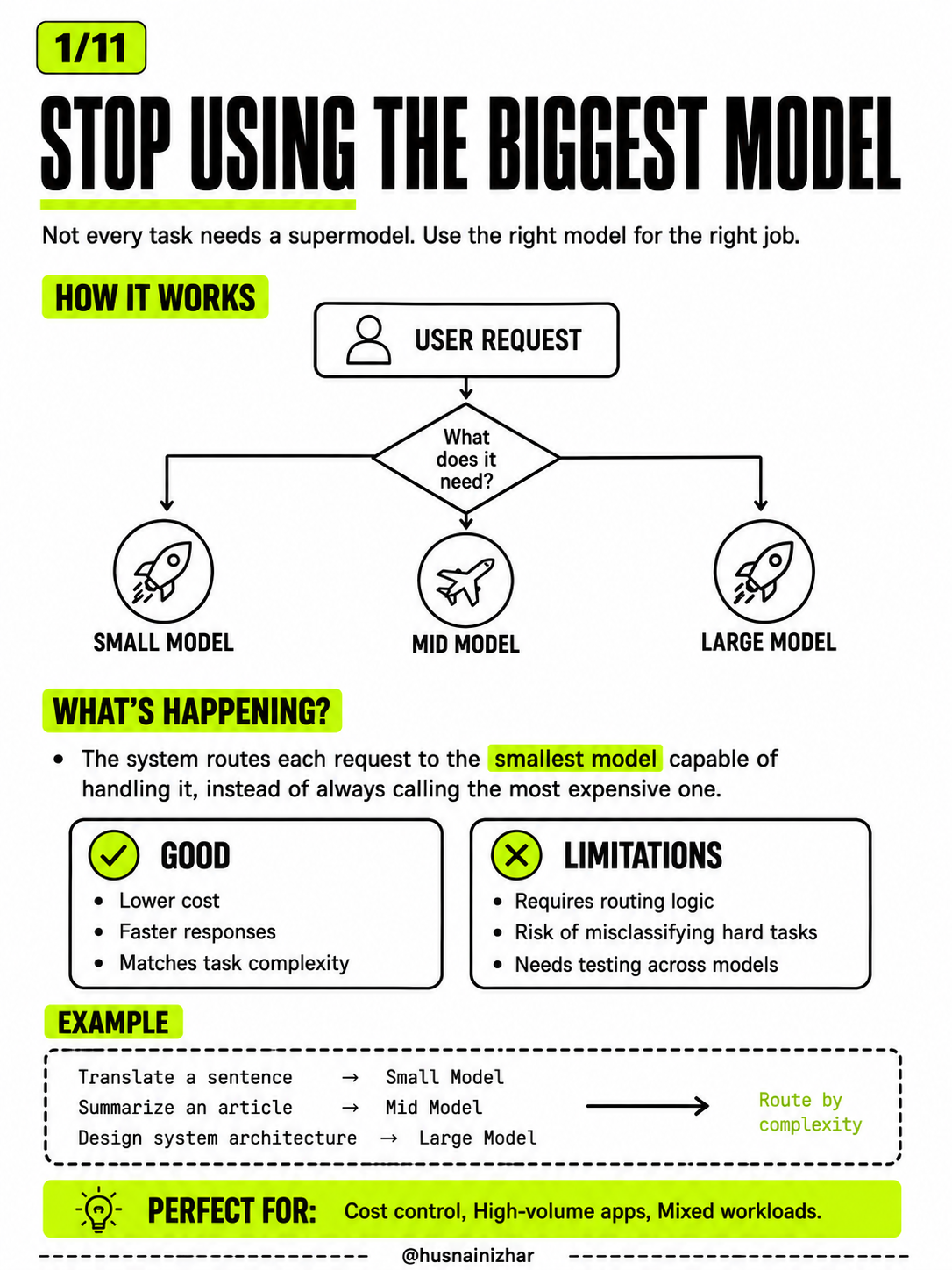
Not every task needs a supermodel. Route each request to the smallest model capable of handling it, instead of always calling the most expensive one.
- Translate a sentence → Small model
- Summarize an article → Mid model
- Design system architecture → Large model
Why it works: lower cost, faster responses, and output that matches task complexity.
Trade-offs: you need routing logic, there's a risk of misclassifying hard tasks, and it requires testing across models.
Best for: cost control, high-volume apps, mixed workloads.
2. Your Prompt Is Too Big
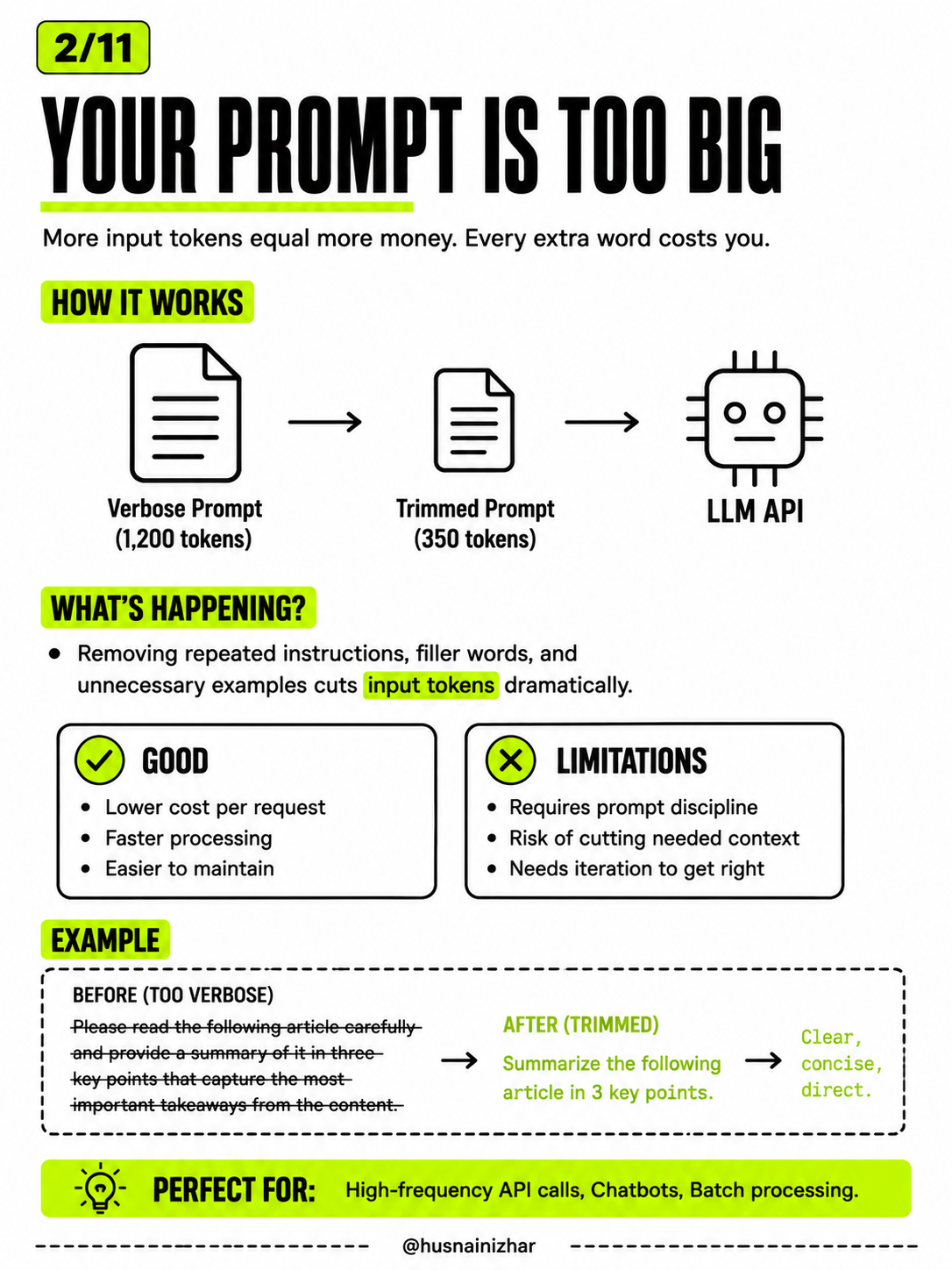
More input tokens equal more money — every extra word costs you. Cut repeated instructions, filler words, and unnecessary examples to shrink your prompts dramatically.
Example:
- Before (verbose, ~1,200 tokens): "Please read the following article carefully and provide a summary of it in three key points that capture the most important takeaways from the content."
- After (trimmed, ~350 tokens): "Summarize the following article in 3 key points."
Why it works: lower cost per request, faster processing, easier to maintain.
Trade-offs: requires prompt discipline, risk of cutting needed context, needs iteration to get right.
Best for: high-frequency API calls, chatbots, batch processing.
3. Stop Sending Full Chat History
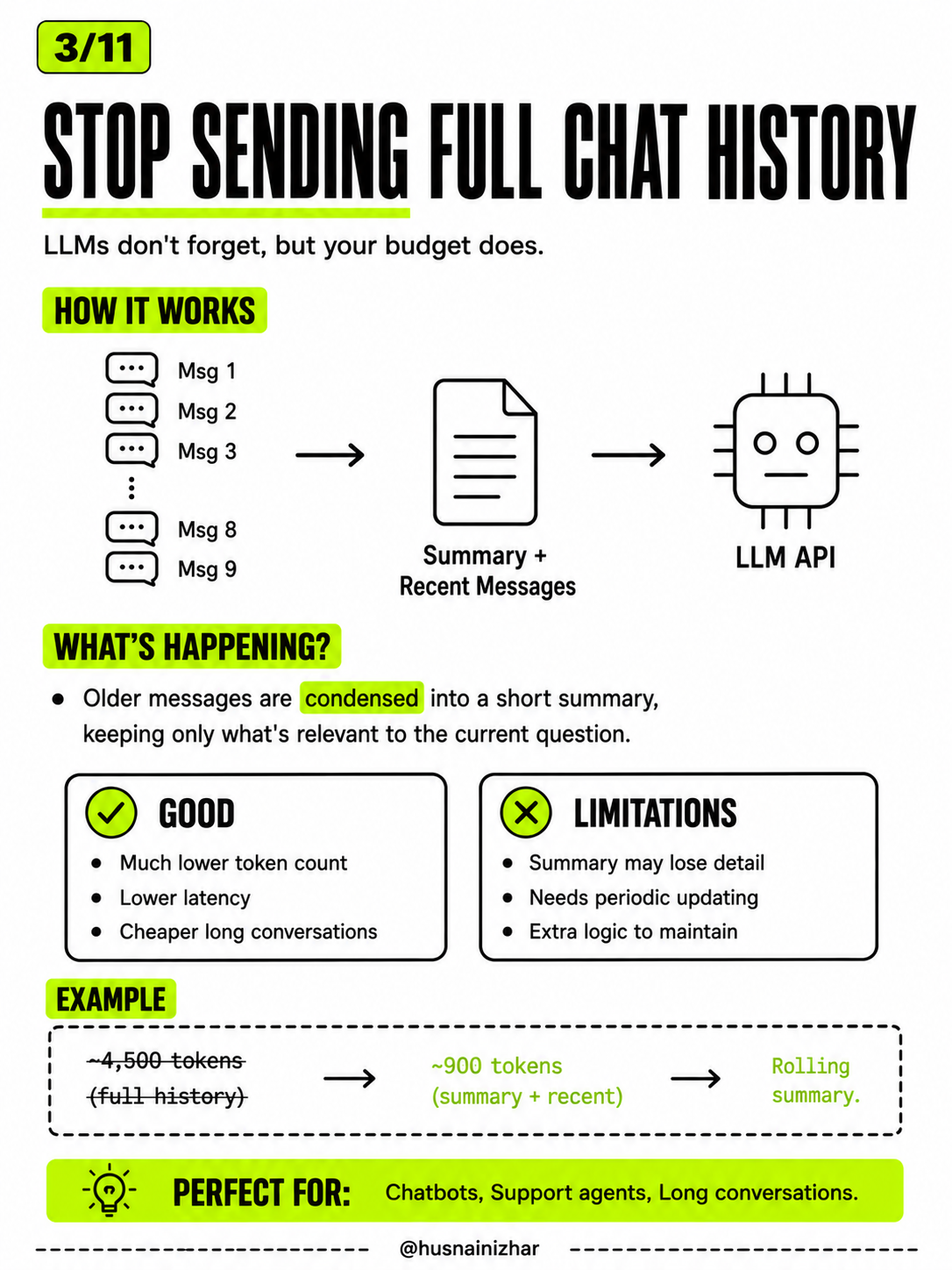
LLMs don't forget, but your budget does. Instead of resending every message in a conversation, condense older messages into a short summary and keep only what's relevant to the current question.
Example: ~4,500 tokens (full history) → ~900 tokens (summary + recent messages), using a rolling summary.
Why it works: much lower token count, lower latency, cheaper long conversations.
Trade-offs: summaries may lose detail, need periodic updating, and add extra logic to maintain.
Best for: chatbots, support agents, long conversations.
4. Don't Let the Model Write a Novel
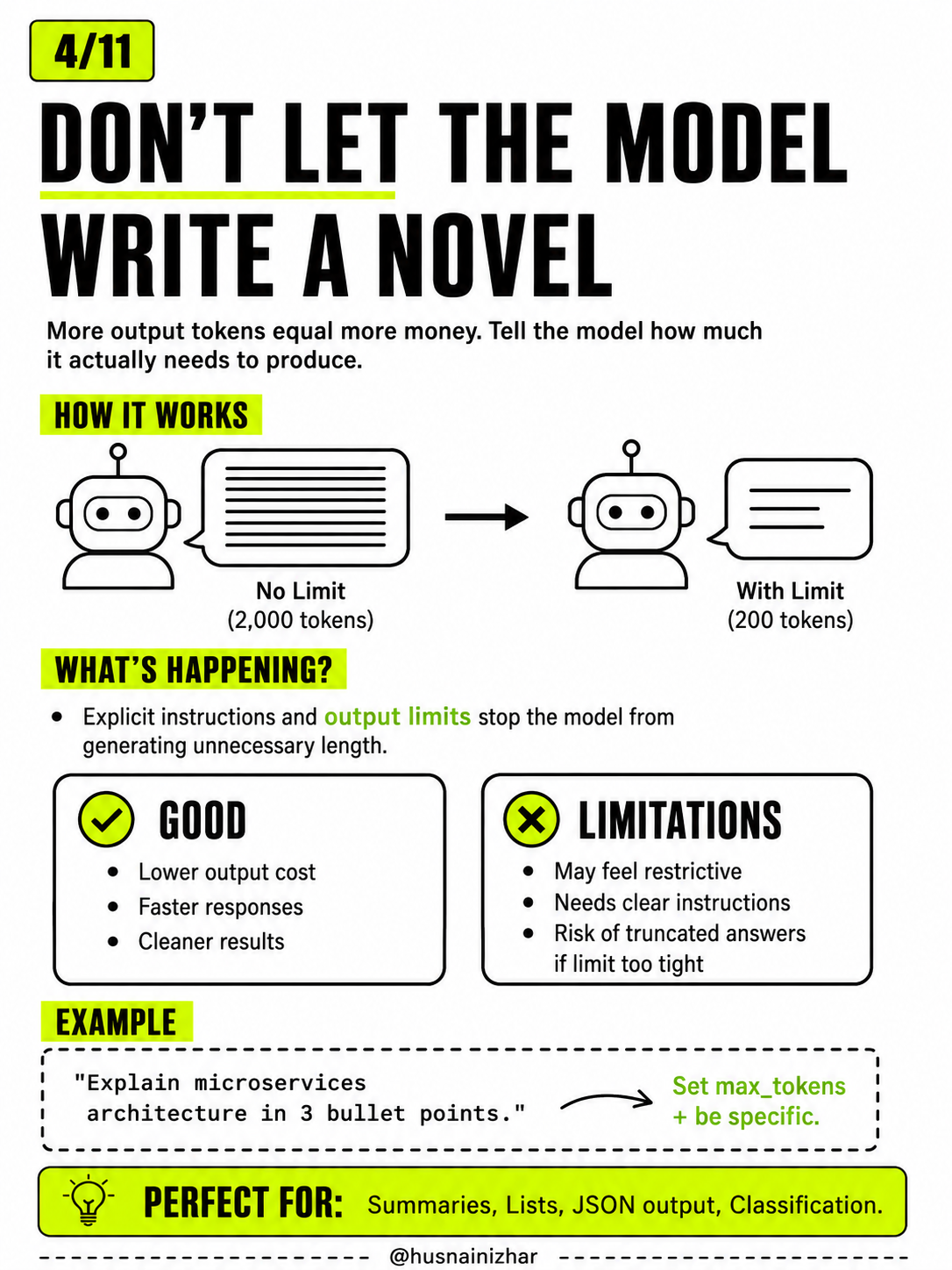
More output tokens equal more money too. Give the model explicit instructions and output limits so it doesn't generate more than it needs to.
Example: "Explain microservices architecture in 3 bullet points." → set max_tokens and be specific (e.g., 200 tokens instead of 2,000).
Why it works: lower output cost, faster responses, cleaner results.
Trade-offs: may feel restrictive, needs clear instructions, risk of truncated answers if the limit is too tight.
Best for: summaries, lists, JSON output, classification.
5. Same Question? Don't Pay Twice
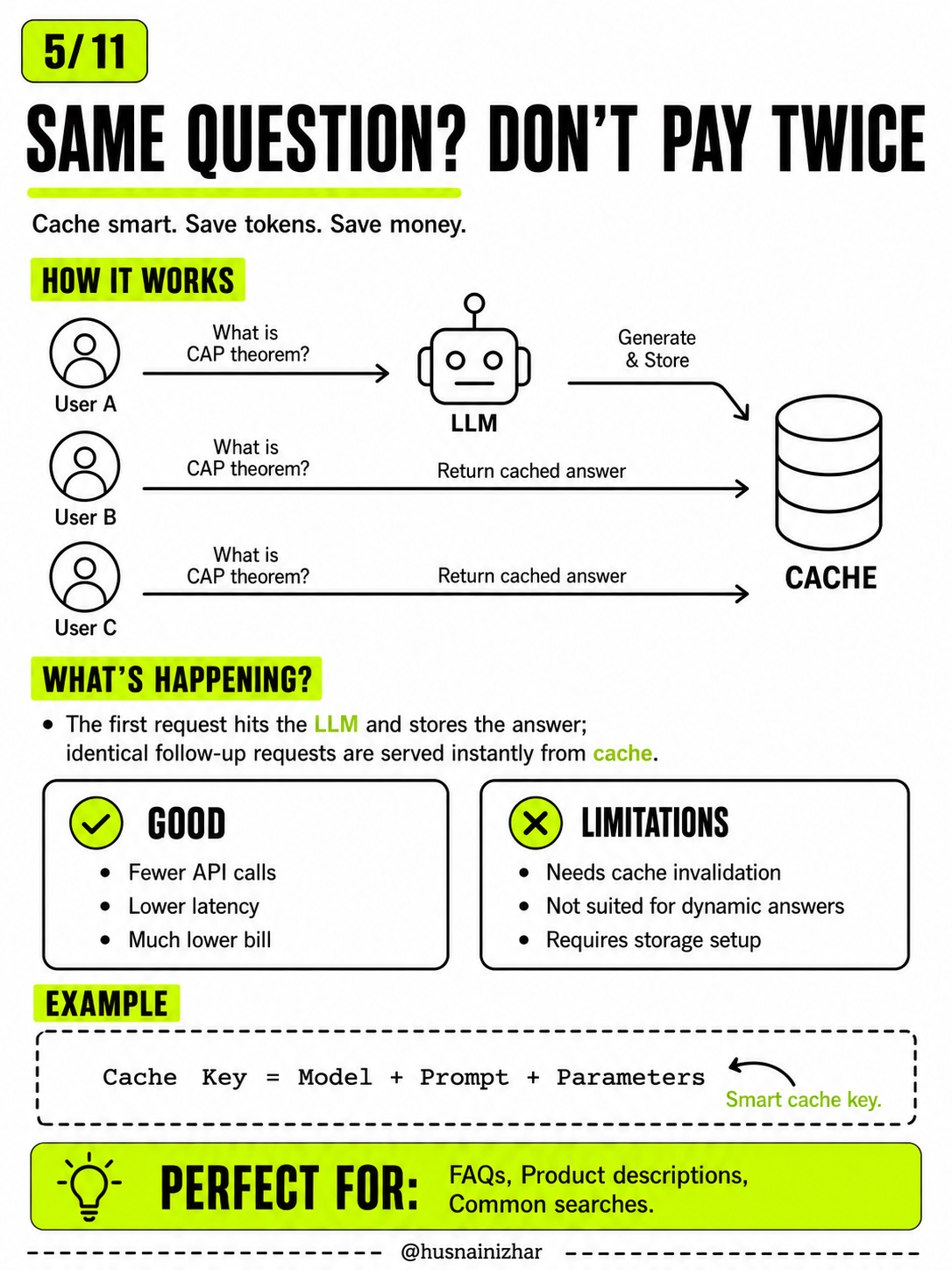
Cache smart, save tokens, save money. The first request hits the LLM and stores the answer; identical follow-up requests are served instantly from cache instead of hitting the API again.
Example cache key: Model + Prompt + Parameters
Why it works: fewer API calls, lower latency, much lower bill.
Trade-offs: needs cache invalidation, not suited for dynamic answers, requires storage setup.
Best for: FAQs, product descriptions, common searches.
6. Don't Send the Whole Document
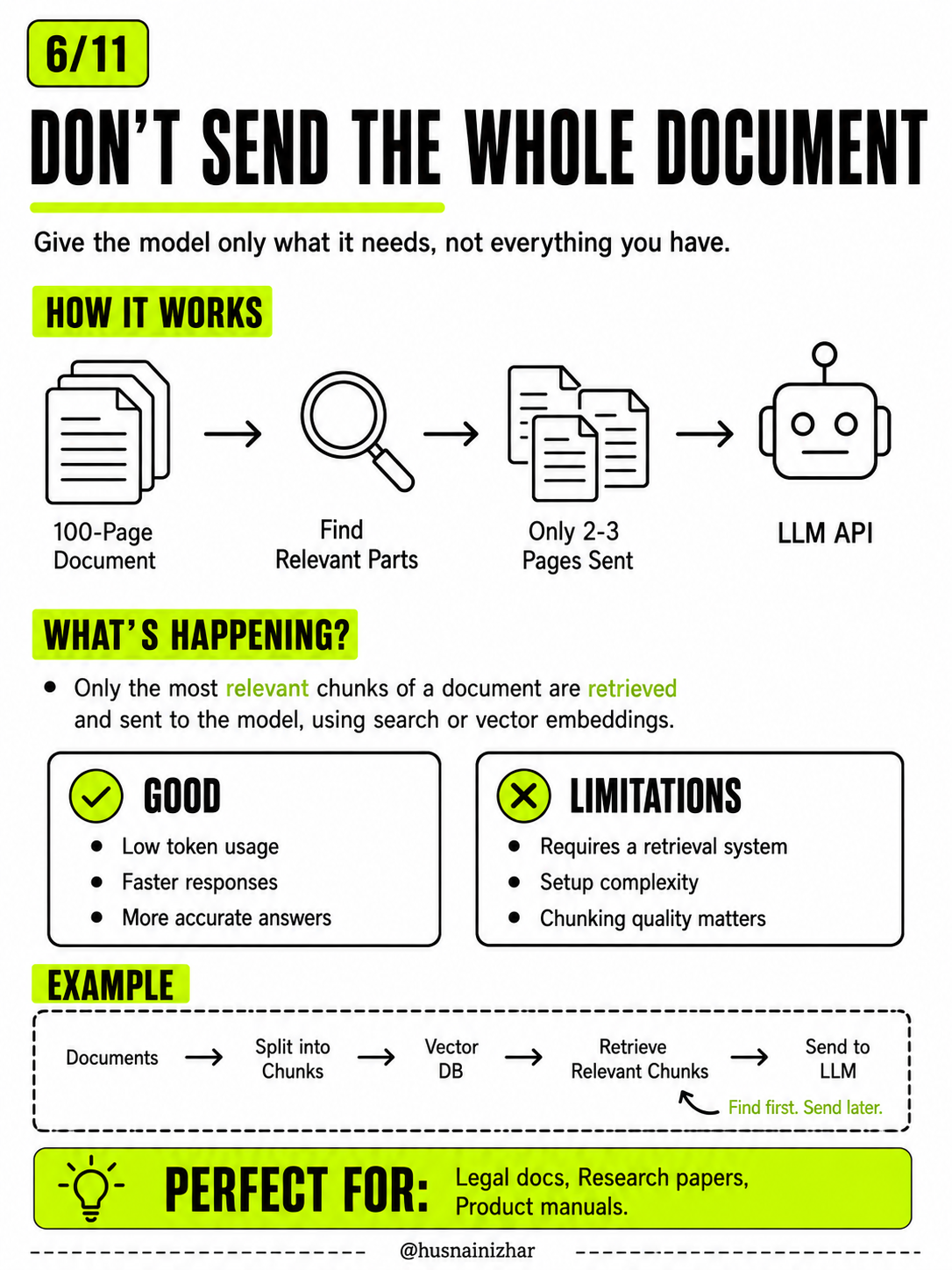
Give the model only what it needs, not everything you have. Instead of sending a 100-page document, retrieve only the most relevant chunks — using search or vector embeddings — and send just those.
Flow: Documents → split into chunks → vector DB → retrieve relevant chunks → send to LLM. Find first, send later.
Why it works: low token usage, faster responses, more accurate answers.
Trade-offs: requires a retrieval system, adds setup complexity, and chunking quality matters.
Best for: legal docs, research papers, product manuals.
7. Batch the Work
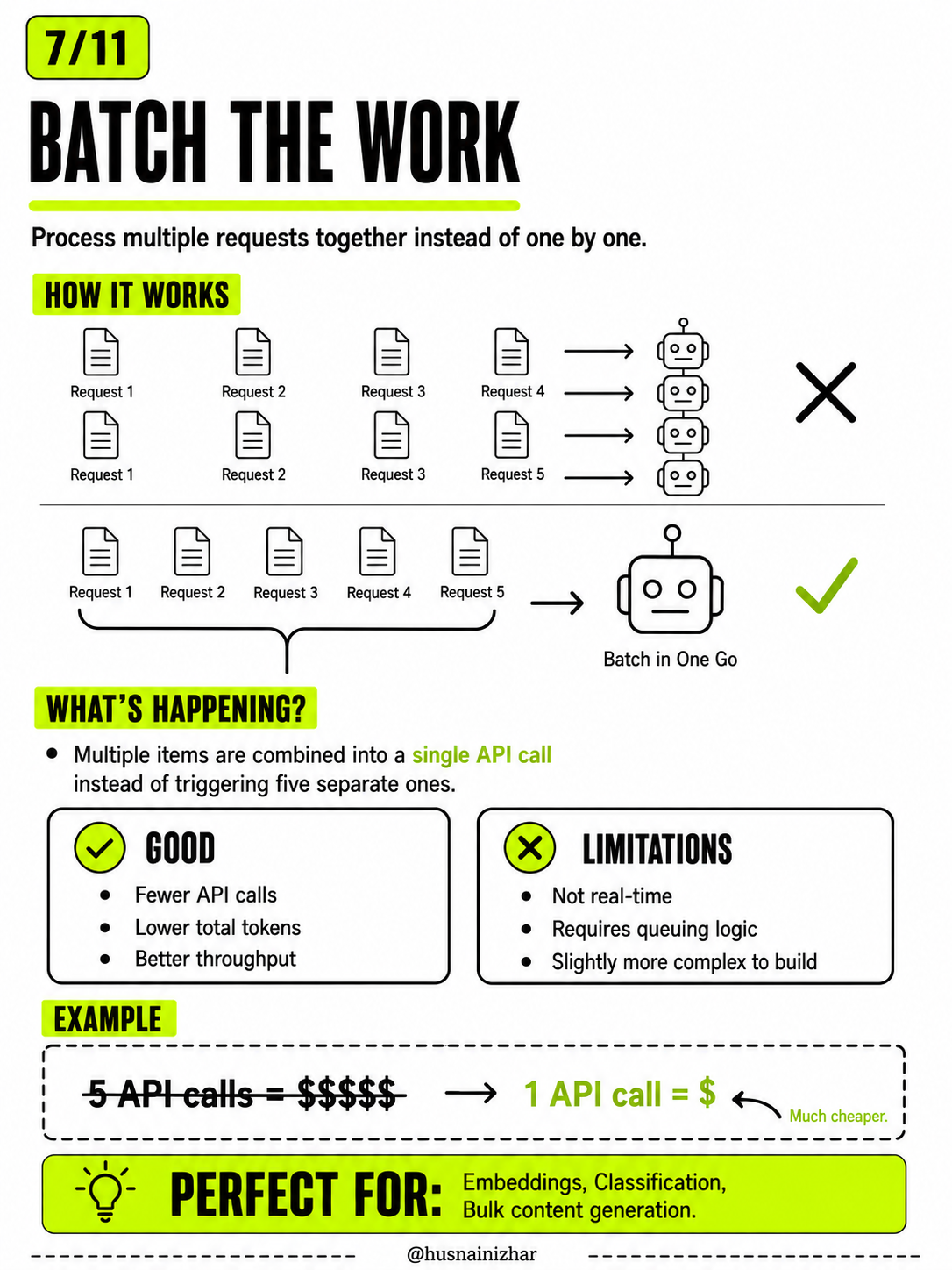
Process multiple requests together instead of one by one. Combine multiple items into a single API call instead of triggering five separate ones.
Example: 5 separate API calls = $$$$$ → 1 batched API call = $ (much cheaper).
Why it works: fewer API calls, lower total tokens, better throughput.
Trade-offs: not real-time, requires queuing logic, slightly more complex to build.
Best for: embeddings, classification, bulk content generation.
8. Not Everything Needs an Instant Answer
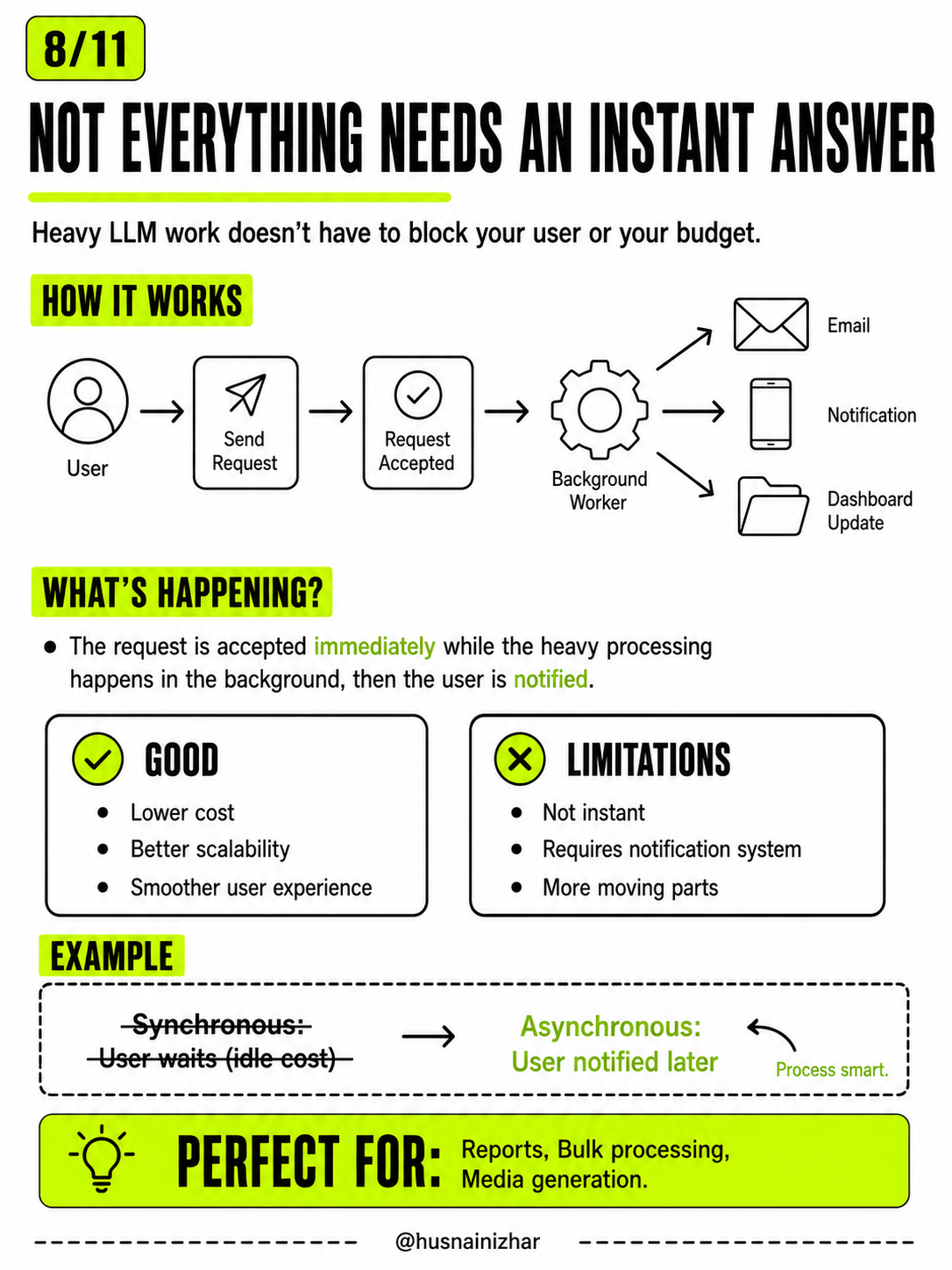
Heavy LLM work doesn't have to block your user or your budget. Accept the request immediately, process it in the background, and notify the user when it's done.
Flow: User → send request → request accepted → background worker → email / notification / dashboard update.
Why it works: lower cost, better scalability, smoother user experience.
Trade-offs: not instant, requires a notification system, more moving parts.
Best for: reports, bulk processing, media generation.
9. Paying for the Same Request Twice
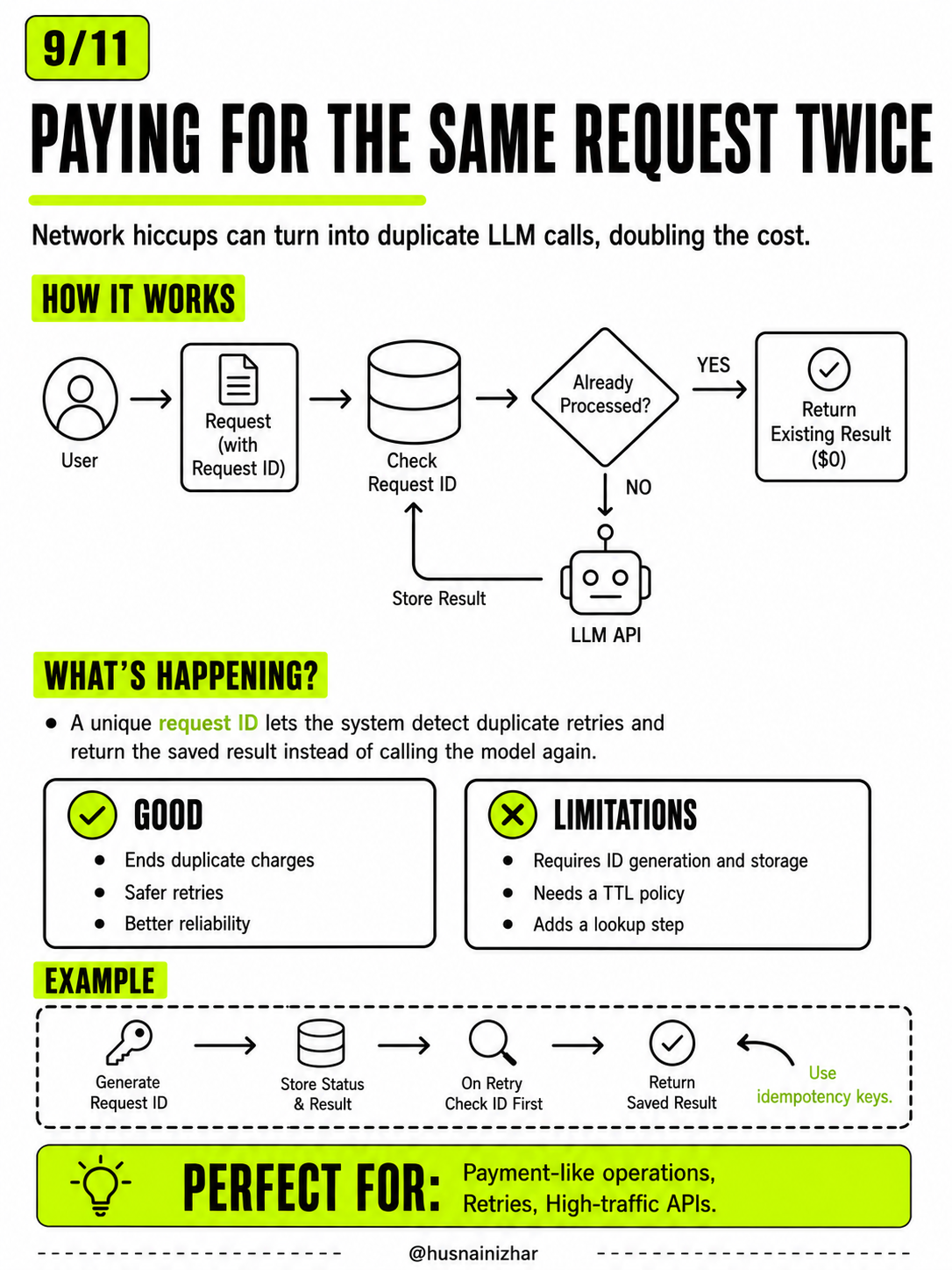
Network hiccups can turn into duplicate LLM calls, doubling the cost. A unique request ID lets the system detect duplicate retries and return the saved result instead of calling the model again.
Flow: generate request ID → store status & result → on retry, check ID first → return saved result. Use idempotency keys.
Why it works: ends duplicate charges, safer retries, better reliability.
Trade-offs: requires ID generation and storage, needs a TTL policy, adds a lookup step.
Best for: payment-like operations, retries, high-traffic APIs.
10. Do You Really Need AI Here?
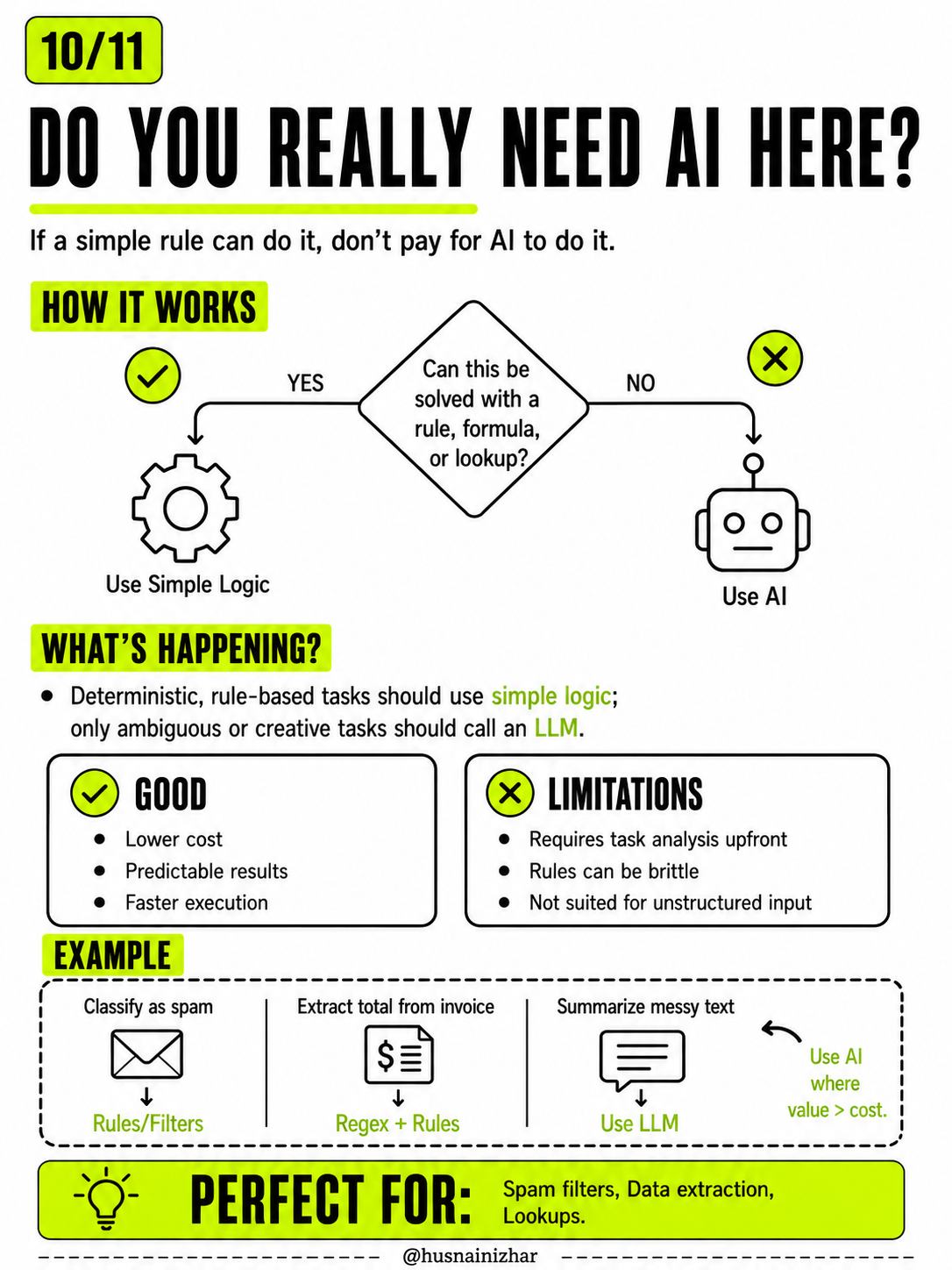
If a simple rule can do it, don't pay for AI to do it. Deterministic, rule-based tasks should use simple logic; only ambiguous or creative tasks should call an LLM.
Examples:
- Classify as spam → rules/filters
- Extract total from invoice → regex + rules
- Summarize messy text → use an LLM
Use AI only where the value exceeds the cost.
Why it works: lower cost, predictable results, faster execution.
Trade-offs: requires task analysis upfront, rules can be brittle, not suited for unstructured input.
Best for: spam filters, data extraction, lookups.
11. You Can't Reduce What You Don't Measure
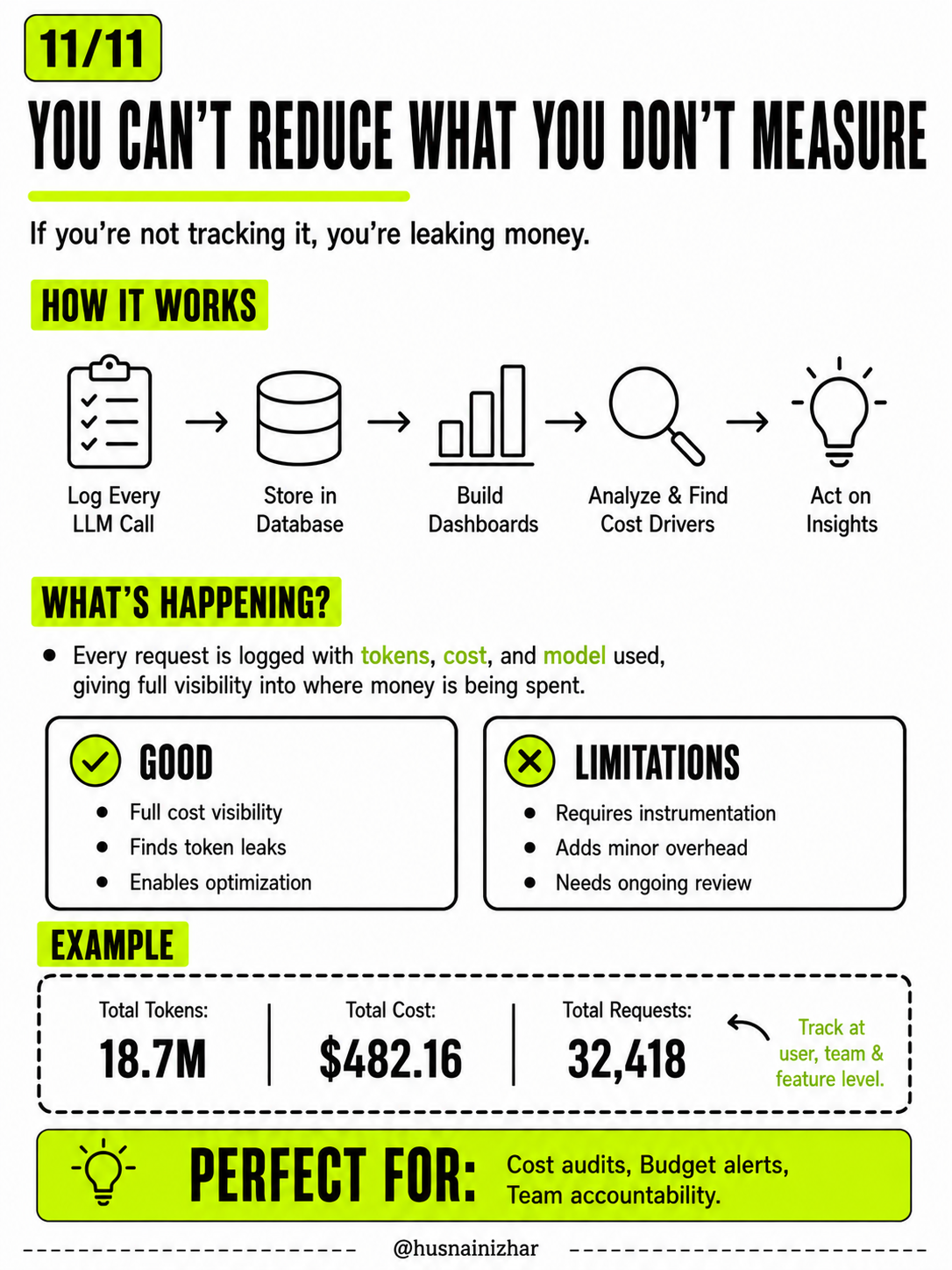
If you're not tracking it, you're leaking money. Log every LLM call — tokens, cost, and model used — store it, build dashboards, analyze cost drivers, and act on what you find.
Flow: Log every LLM call → store in database → build dashboards → analyze & find cost drivers → act on insights.
Example numbers to track: total tokens, total cost, total requests — at the user, team, and feature level.
Why it works: full cost visibility, finds token leaks, enables optimization.
Trade-offs: requires instrumentation, adds minor overhead, needs ongoing review.
Best for: cost audits, budget alerts, team accountability.
The Takeaway
None of these techniques require abandoning AI — they just require using it deliberately. Route requests to the right-sized model, trim what you send, cache what repeats, batch what can wait, and measure everything. Do that consistently, and your LLM bill stops being a mystery and starts being a lever you control.