Generative AI vs AI Agent vs Agentic AI: What's Actually the Difference?
If you've spent any time on tech Twitter, LinkedIn, or in a product meeting lately, you've heard these three terms thrown around like they mean the same thing: Generative AI, AI Agent, and Agentic AI.
They don't.
Each one represents a fundamentally different level of autonomy, and understanding the difference isn't just semantics — it changes how you architect systems, what you can trust the AI to do unsupervised, and where things can go wrong.
Let's break it down properly.
1. Generative AI: The Content Creator
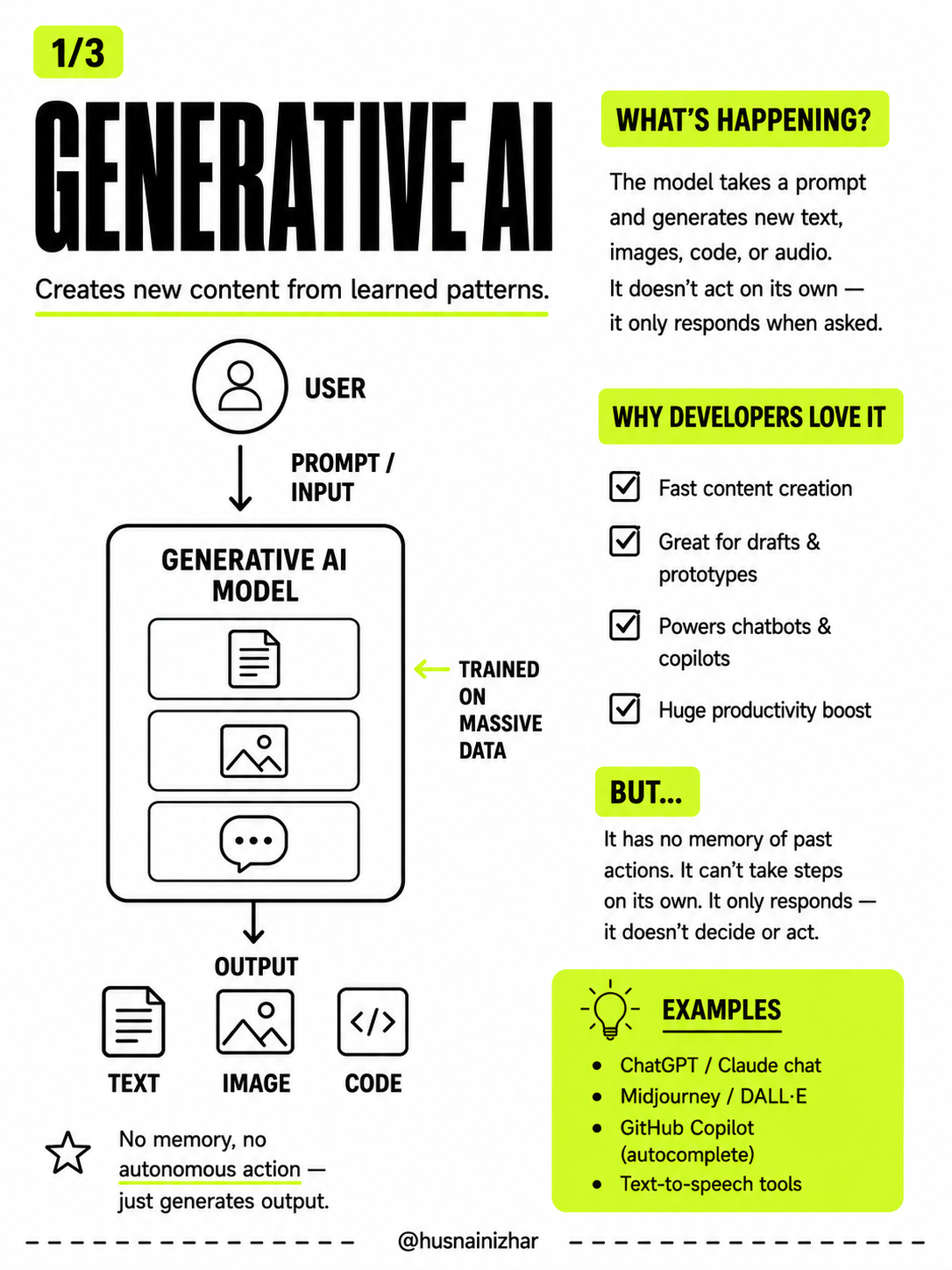
Definition: Generative AI creates new content — text, images, code, or audio — based on patterns learned from massive amounts of training data.
How it works
- A user provides a prompt or input.
- The model, trained on huge datasets, processes that input.
- It generates output — text, an image, a snippet of code, whatever it was trained to produce.
- That's it. The interaction ends there.
There's no memory of past interactions (beyond the current context window), no ability to take independent action, and no decision-making beyond "what's the best next token/pixel to generate."
Why developers love it
- Fast content creation
- Great for drafts and prototypes
- Powers chatbots and copilots
- Massive productivity boost for repetitive creative work
The limitation
Generative AI has no memory of past actions and can't take steps on its own. It only responds — it never decides or acts. If you want it to do something, you have to ask it, every single time.
Real-world examples
- ChatGPT / Claude (chat mode)
- Midjourney / DALL·E
- GitHub Copilot (autocomplete)
- Text-to-speech tools
2. AI Agent: The Task Executor
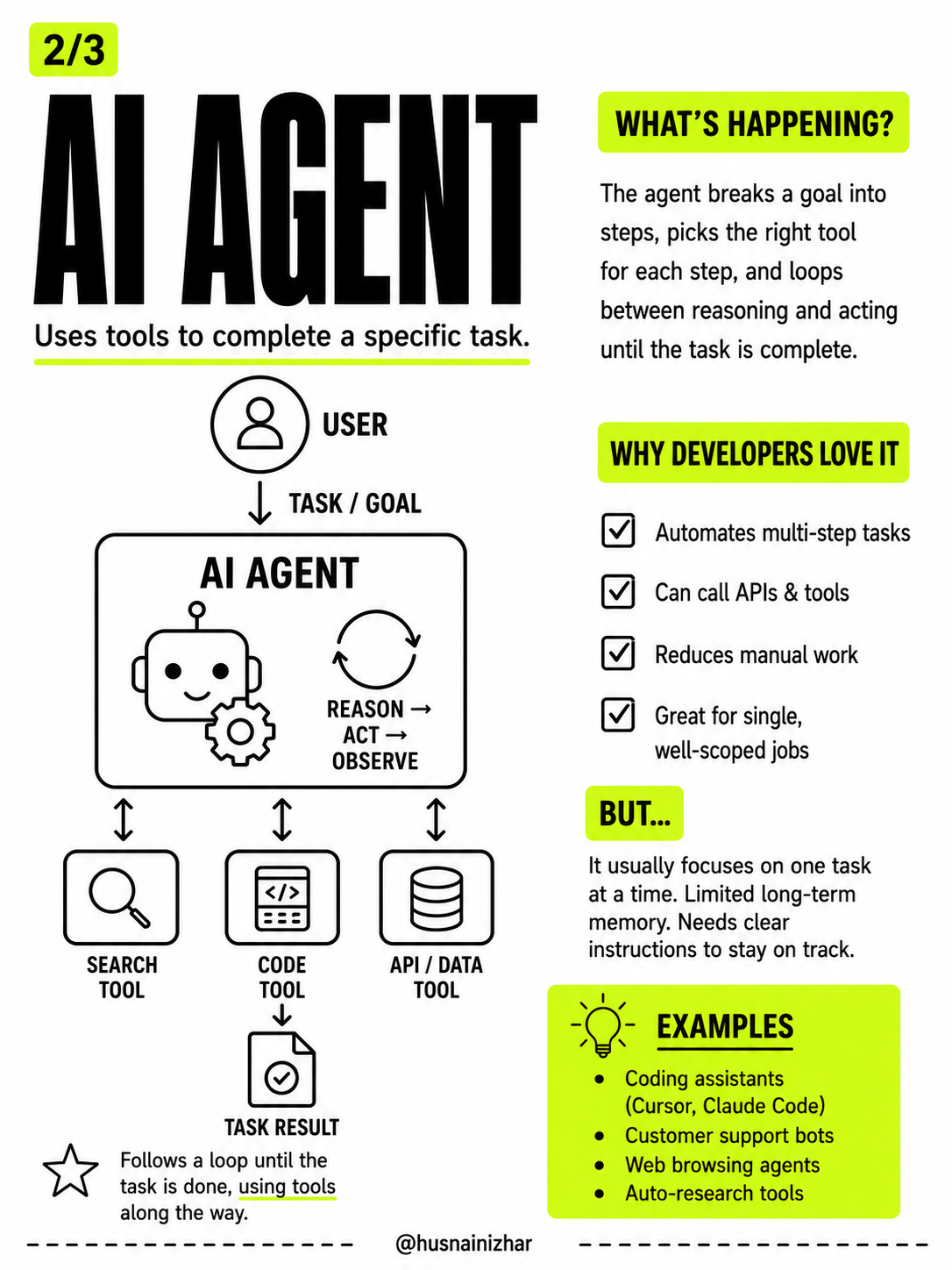
Definition: An AI Agent uses tools to complete a specific, well-defined task. It doesn't just generate — it reasons, acts, and observes the results, looping through that cycle until the job is done.
How it works
- A user gives the agent a task or goal.
- The agent breaks that goal into steps.
- For each step, it decides which tool to use — a search tool, a code execution tool, an API/database tool.
- It calls the tool, observes the result, and decides the next step.
- This reason → act → observe loop repeats until the task is complete.
- The agent returns a final result.
This is a meaningful jump from generative AI. The system is no longer just producing output — it's making decisions about how to get to an outcome, and it can interact with the outside world through tools.
Why developers love it
- Automates multi-step tasks
- Can call APIs and external tools
- Reduces manual, repetitive work
- Great for single, well-scoped jobs
The limitation
AI agents are still narrow. They typically focus on one task at a time, have limited long-term memory, and need clear instructions to stay on track. Ask it to do too much at once, and it tends to lose the thread.
Real-world examples
- Coding assistants (Cursor, Claude Code)
- Customer support bots
- Web-browsing agents
- Auto-research tools
3. Agentic AI: The Autonomous System
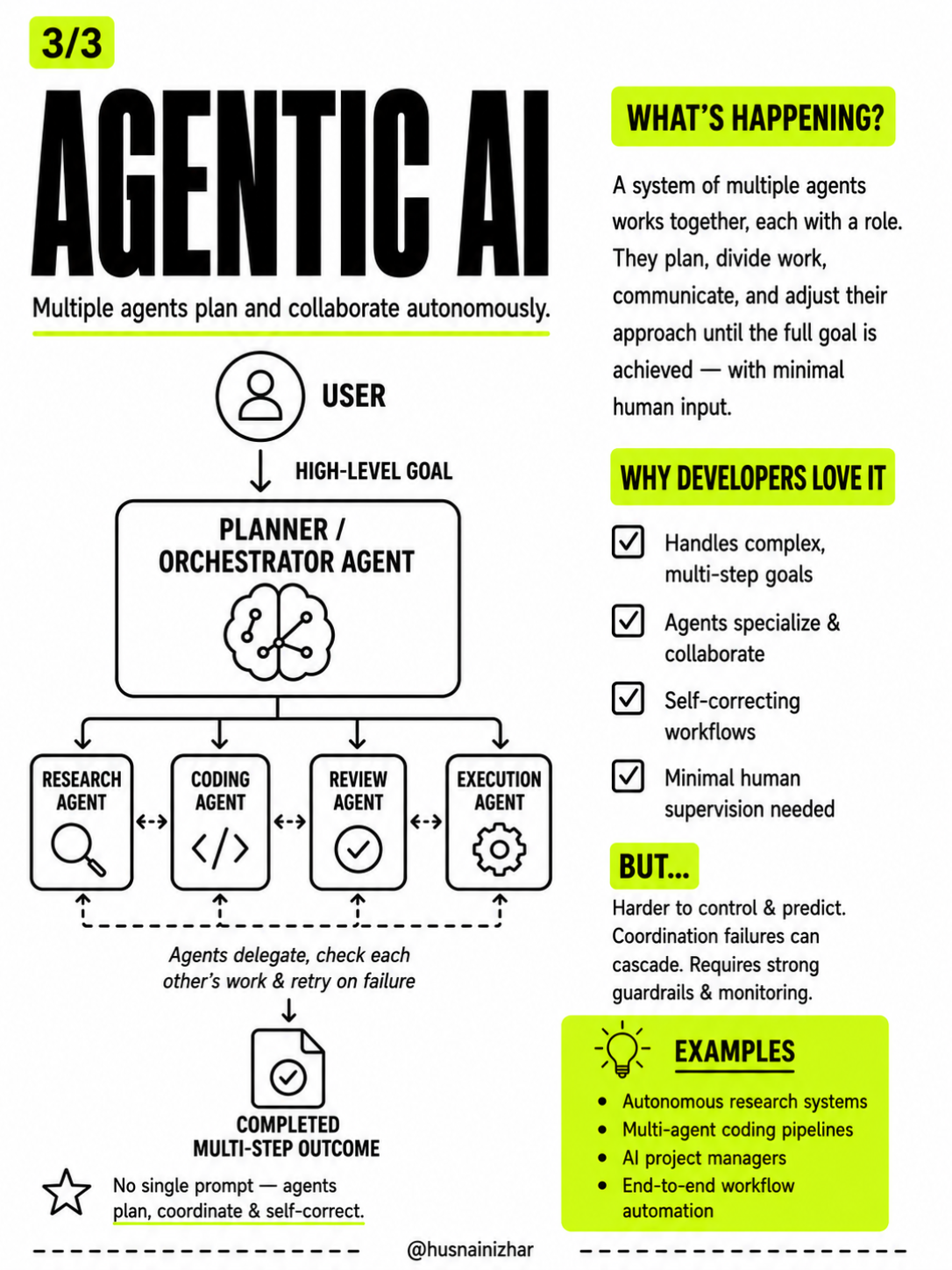
Definition: Agentic AI is a system of multiple agents working together, each with a specialized role. They plan, divide work, communicate with each other, check each other's outputs, and adjust their approach — largely without human input.
How it works
- A user provides a high-level goal (not a step-by-step instruction).
- A planner/orchestrator agent breaks that goal into sub-tasks.
- Specialized sub-agents take over — for example, a research agent, a coding agent, a review agent, and an execution agent.
- These agents communicate, delegate work to each other, and check each other's outputs.
- If something fails, the system retries or re-plans.
- The final, multi-step outcome is delivered — often without a single human intervening along the way.
This is the biggest leap in the chain. It's not one model doing one job — it's an orchestrated team of specialized agents solving a complex problem the way a small team of humans might.
Why developers love it
- Handles complex, multi-step goals
- Agents specialize and collaborate
- Self-correcting workflows
- Requires minimal human supervision
The limitation
With great autonomy comes great complexity. Agentic systems are harder to control and predict. Coordination failures in one agent can cascade into the rest of the system. This requires strong guardrails, monitoring, and fallback logic — you can't just "set it and forget it."
Real-world examples
- Autonomous research systems
- Multi-agent coding pipelines
- AI project managers
- End-to-end workflow automation
Side-by-Side Comparison
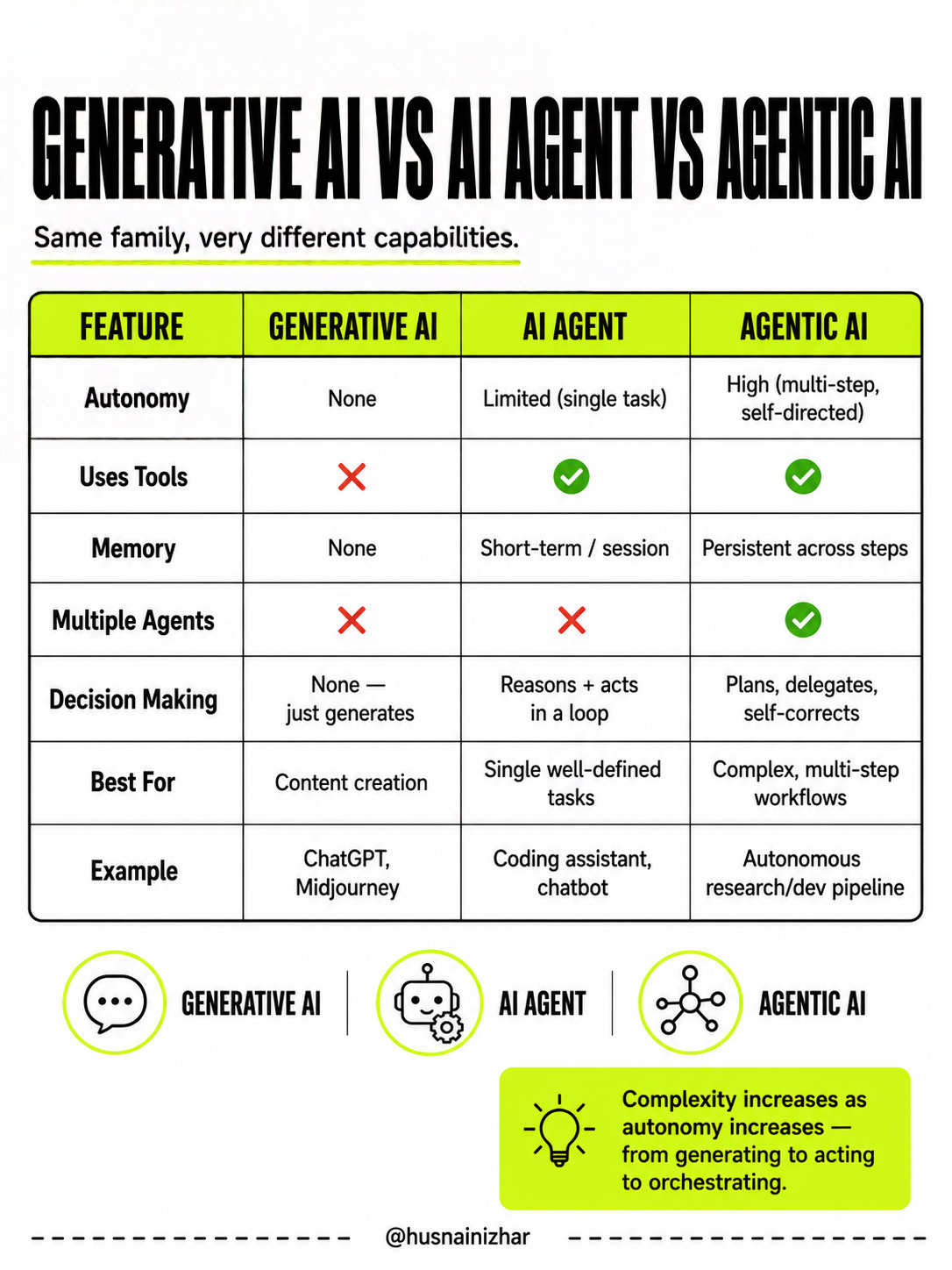
| Feature | Generative AI | AI Agent | Agentic AI |
|---|---|---|---|
| Autonomy | None | Limited (single task) | High (multi-step, self-directed) |
| Uses Tools | ❌ | ✅ | ✅ |
| Memory | None | Short-term / session | Persistent across steps |
| Multiple Agents | ❌ | ❌ | ✅ |
| Decision Making | None — just generates | Reasons + acts in a loop | Plans, delegates, self-corrects |
| Best For | Content creation | Single, well-defined tasks | Complex, multi-step workflows |
| Example | ChatGPT, Midjourney | Coding assistant, chatbot | Autonomous research/dev pipeline |
The Big Picture

Here's the pattern to remember:
Complexity increases as autonomy increases — from generating, to acting, to orchestrating.
- Generative AI answers the question: "What should I create?"
- AI Agents answer: "How do I complete this task using the tools available to me?"
- Agentic AI answers: "How do multiple specialized systems work together to solve something none of them could solve alone?"
None of these is inherently "better" than the others — they solve different problems. A simple content-generation task doesn't need a multi-agent orchestration system any more than a complex, multi-step business workflow can be solved with a single prompt to a generative model.
The real skill in building with AI today isn't picking the fanciest term — it's knowing which level of autonomy your problem actually requires, and building the right guardrails for it.
Which of these are you building with right now — Generative AI, an AI Agent, or a fully Agentic system? I'd love to hear what you're working on.