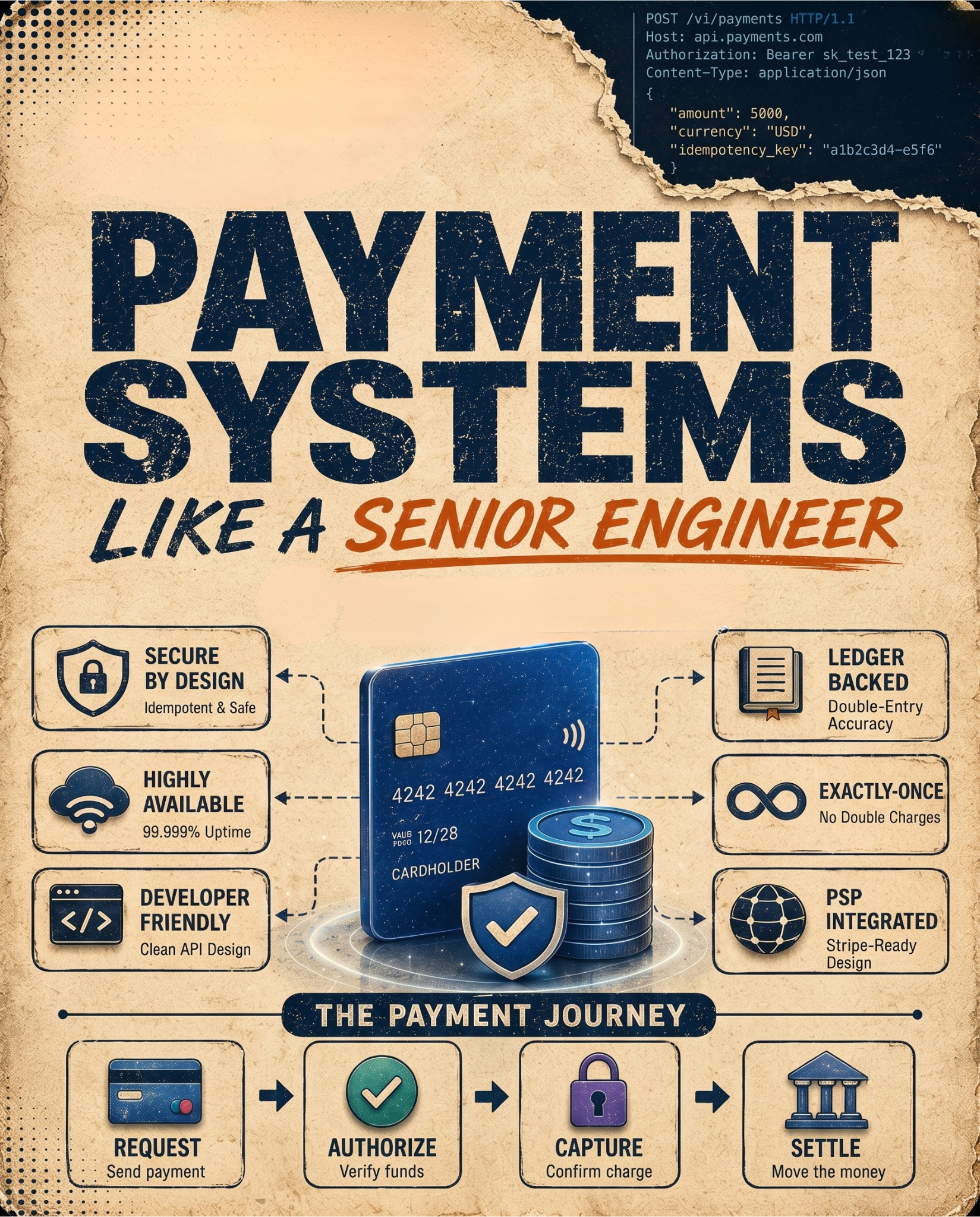
How Payment Systems Really Work: A Senior Engineer's Guide to Building Reliable Payment Infrastructure
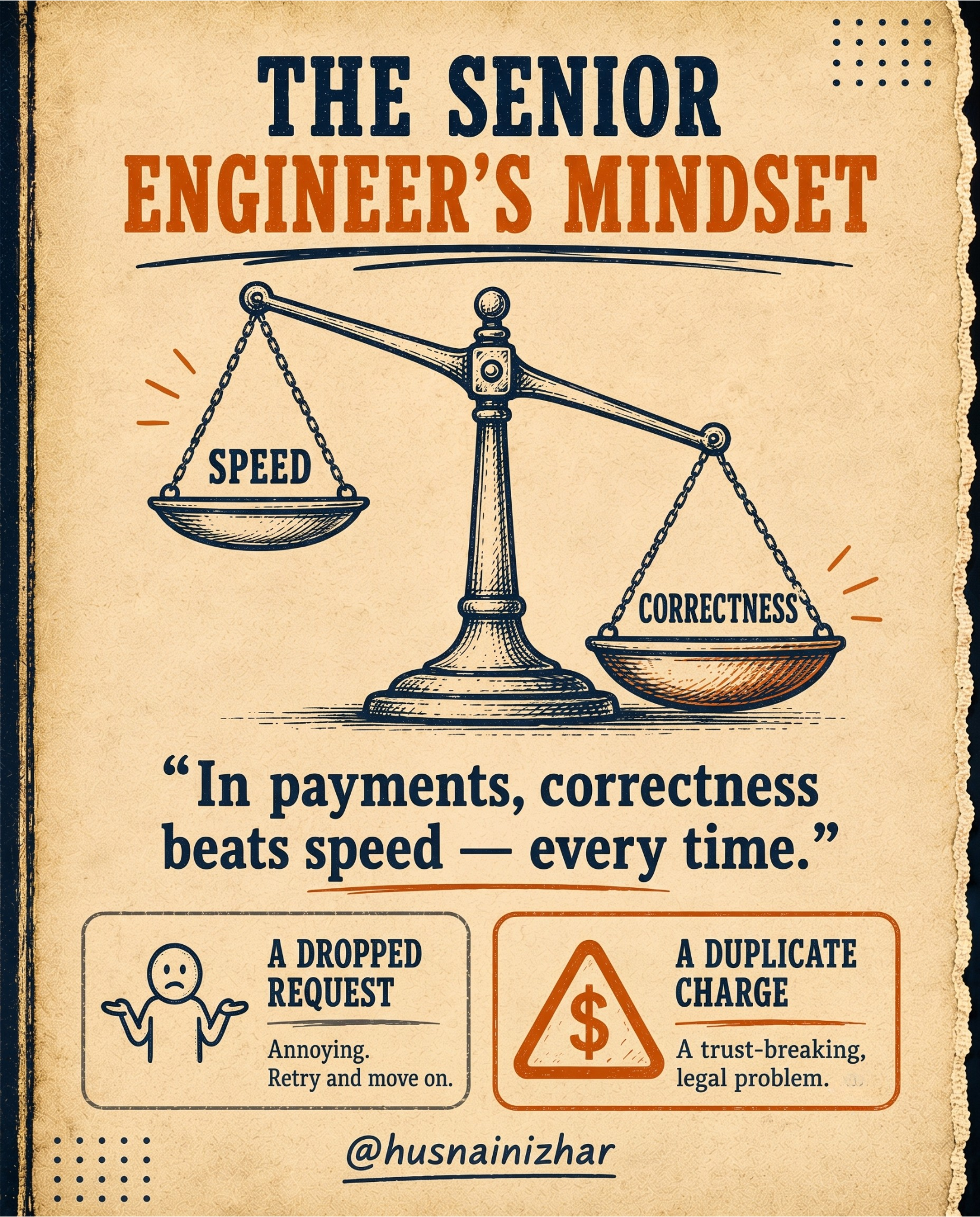
Every payment system looks simple from the outside: a user clicks "Pay," and money moves. But underneath that single click sits one of the most unforgiving categories of software you can build — because in payments, correctness beats speed, every time.
A dropped request is annoying. A duplicate charge is a trust-breaking, legal problem.
Here's how senior engineers actually think about designing payment systems — from the first architectural decision down to the guarantees that keep a ledger trustworthy at scale.
The First Design Question: How Should You Accept Payments?
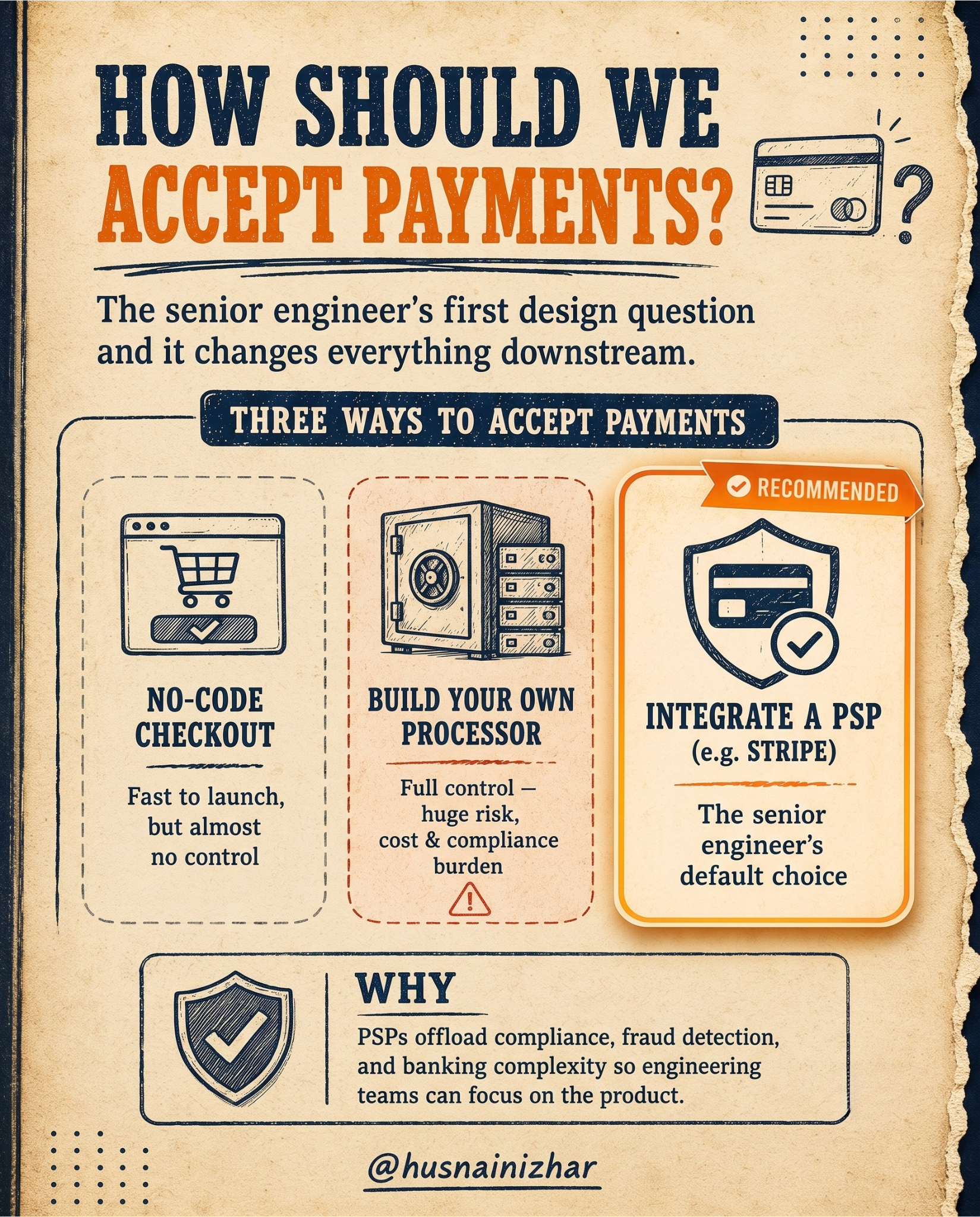
Before any code gets written, every payment system starts with the same fork in the road. There are three ways to accept payments, and each one trades off speed, control, and risk differently:
- Integrate a PSP (like Stripe) — the recommended default for most teams. Fast to launch, with minimal control but a huge amount of complexity offloaded to someone else.
- No-code checkout — the fastest path, but with the least control over the experience.
- Build your own processor — full control, but you inherit the full weight of compliance, fraud detection, and banking complexity.
For most engineering teams, integrating a PSP is the right call. It lets you offload compliance and banking complexity so your team can focus on the actual product instead of reinventing payment rails.
Stop Thinking "Payment." Start Thinking in Phases.
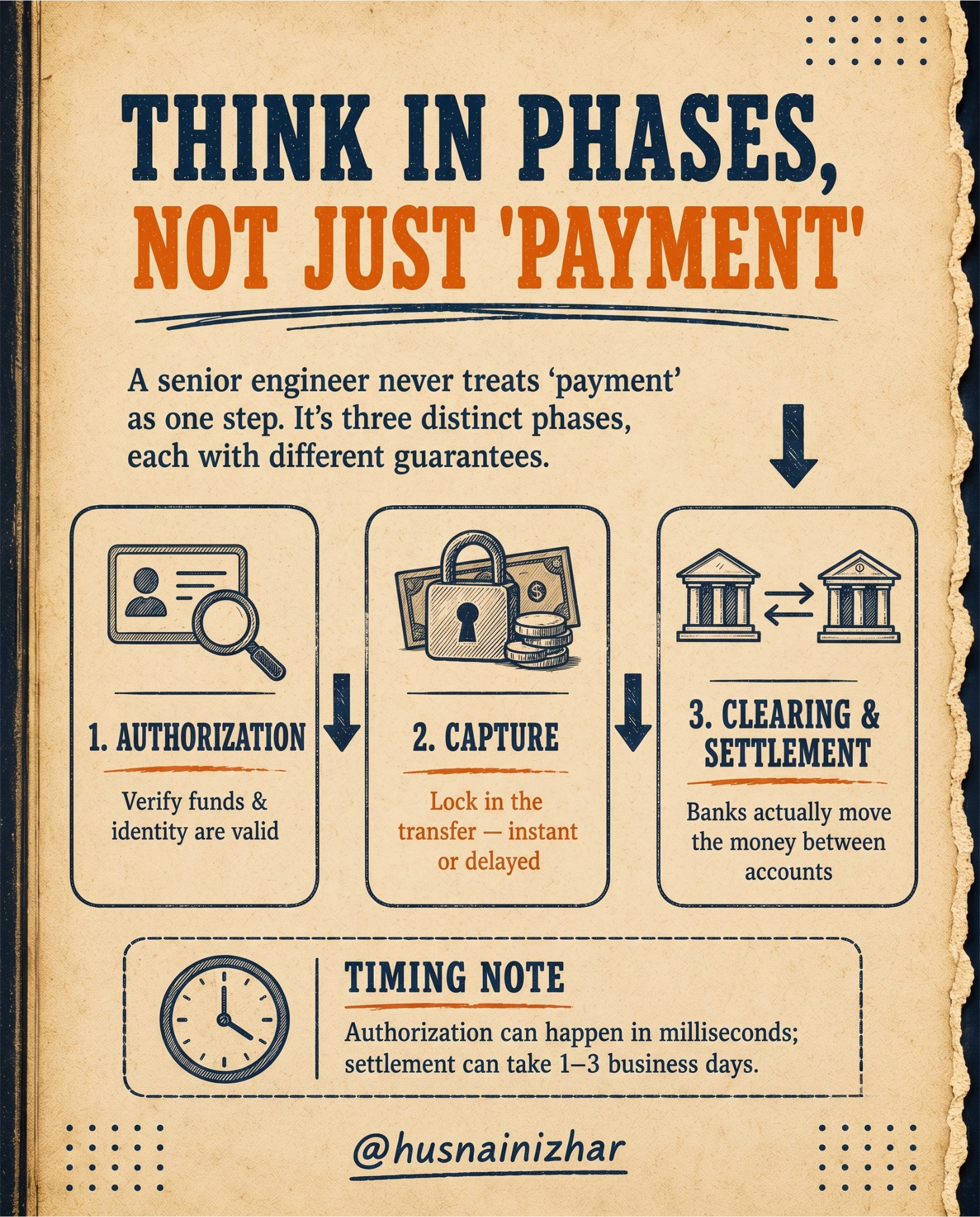
One of the most common mistakes is treating "payment" as a single step. It isn't. It's three distinct phases, each with its own guarantees:
- Authorization — verify that funds and identity are valid.
- Capture — lock in the transfer, either instantly or on a delay.
- Clearing & Settlement — the point where banks actually move money between accounts.
The timing gap between these phases matters more than people expect. Authorization can happen in milliseconds, but settlement can take one to three business days. Any system that doesn't model these phases separately will eventually get the guarantees wrong.
Two Paths, One System
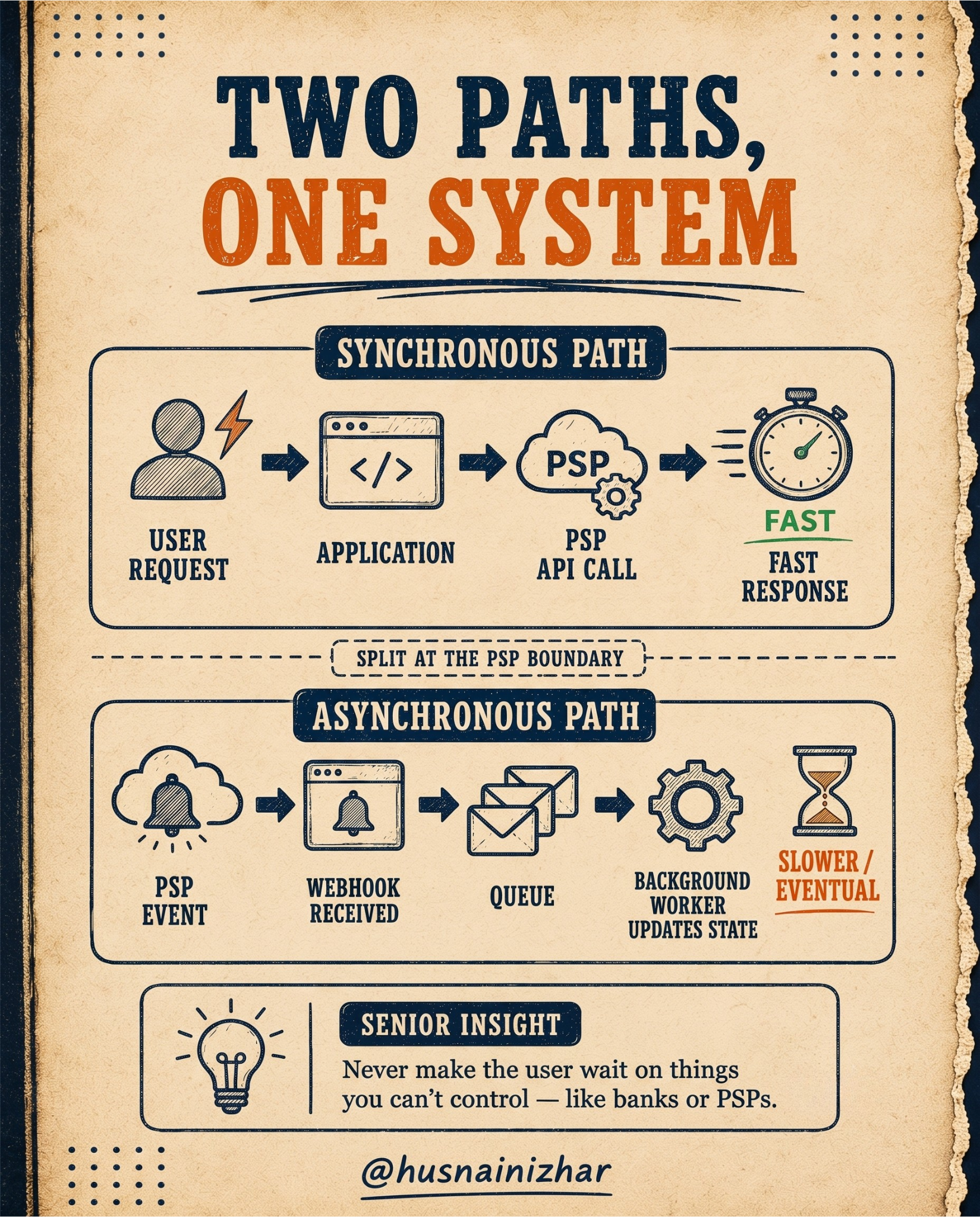
A well-designed payment system runs on two parallel tracks:
- The synchronous path: the user's request hits your application, which calls the PSP's API and gets a fast response.
- The asynchronous path: the PSP sends a webhook event later, which lands in a background queue and is processed by a worker that eventually updates the system's state.
The senior insight here is simple but easy to violate: never make the user wait on things you don't control — like banks or payment processors. Anything that depends on an external party's timing belongs on the async path, not blocking the user's screen.
The #1 Rule: Never Charge Twice
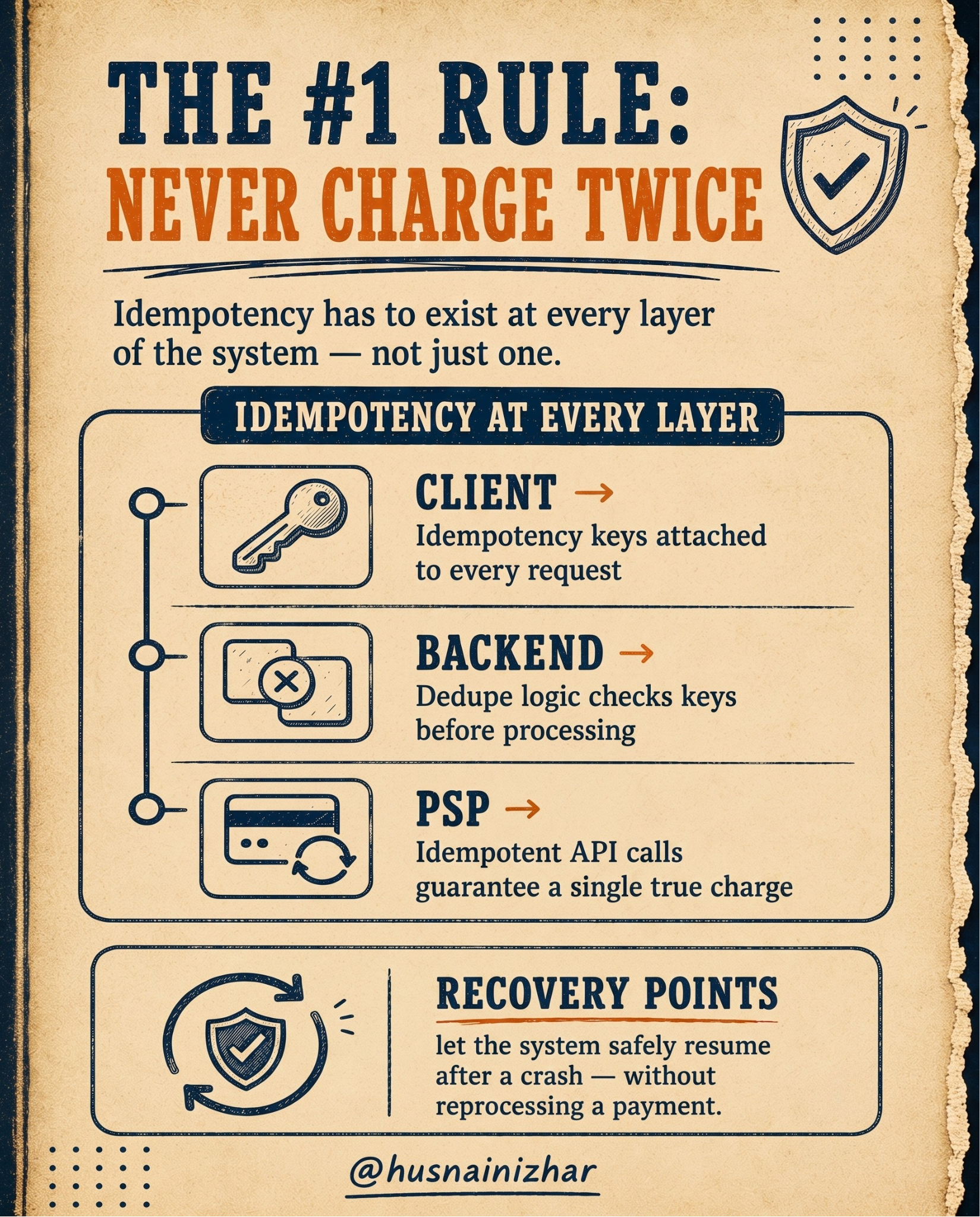
If there's one rule that defines payment engineering, it's this: idempotency has to exist at every layer of the system, not just one.
- At the client, every request carries an idempotency key.
- At the backend, dedupe logic checks those keys before any processing happens.
- At the PSP, idempotent API calls guarantee that only a single true charge is ever created.
This layered approach is also what creates safe recovery points — the ability for a system to resume cleanly after a crash without ever reprocessing a payment it already handled.
Data You Can Always Trust
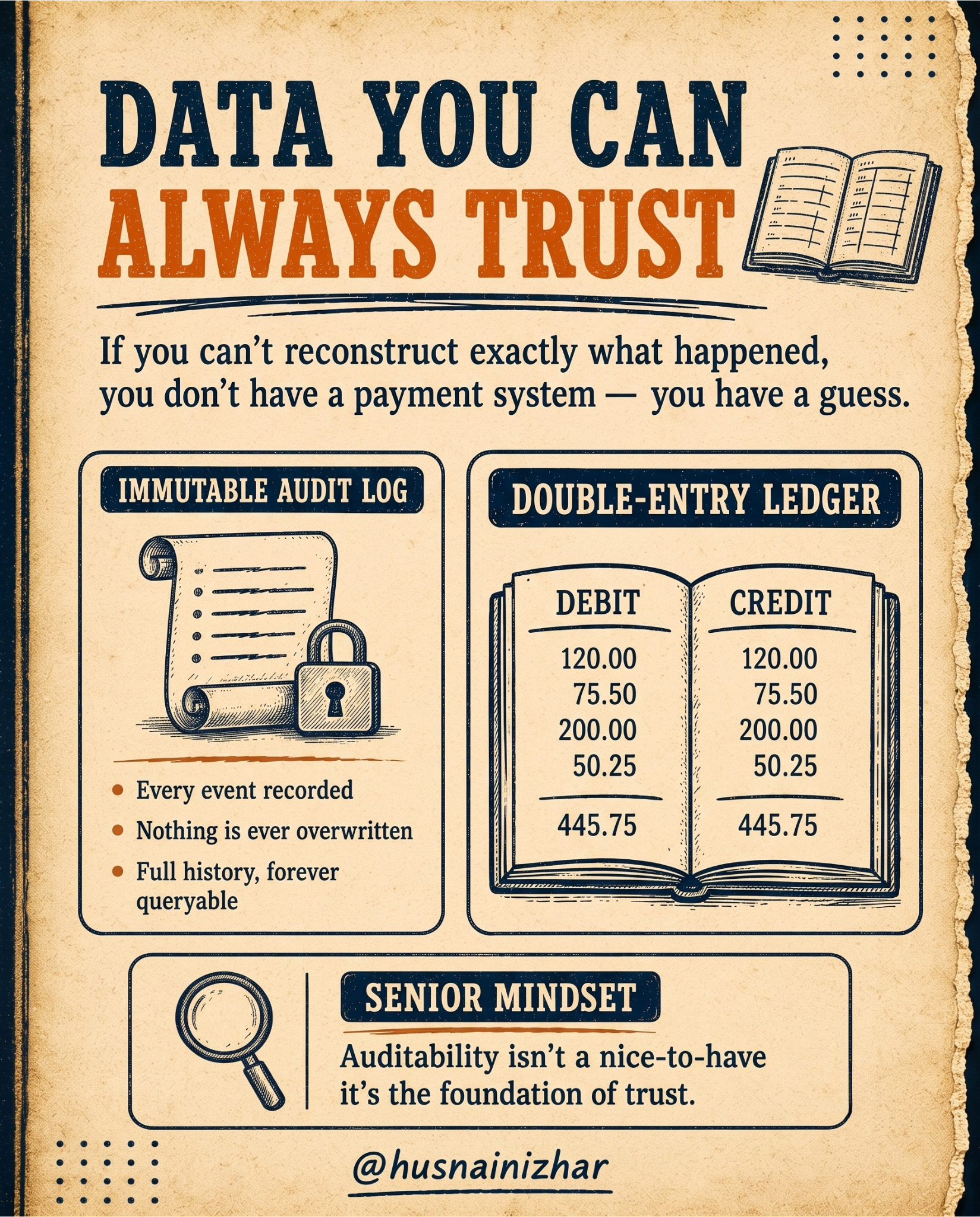
A payment system is only as good as its record-keeping. If you can't reconstruct exactly what happened, you don't have a payment system — you have a guess.
That means:
- Every event gets recorded.
- Nothing is ever overwritten.
- The full history stays queryable, forever.
This is the foundation of an auditable ledger, and auditability isn't a nice-to-have bolted on at the end — it's the foundation of trust in the entire system.
Exactly-Once, Not "Probably Once"
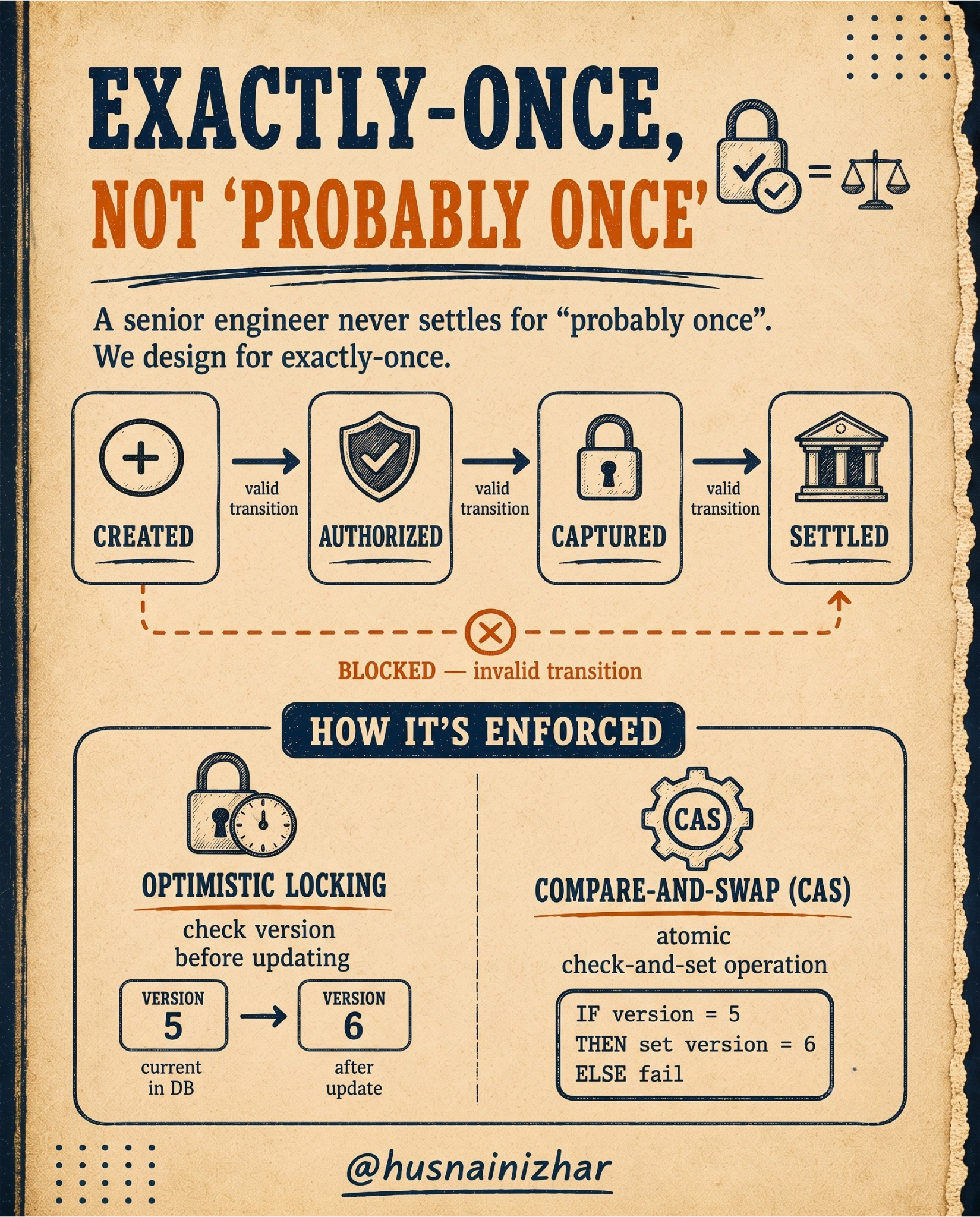
Distributed systems love to promise "at-least-once" or "at-most-once" delivery. Payment systems can't settle for either — they need exactly-once semantics for state transitions. Two patterns make that possible:
- Optimistic locking — check the version before updating, and only proceed if it hasn't changed.
- Compare-and-swap (CAS) — an atomic check-and-set operation: update the version only if it matches the expected value.
Both patterns exist to prevent the same failure mode: two processes racing to update the same record and corrupting the result.
Reliability at Scale
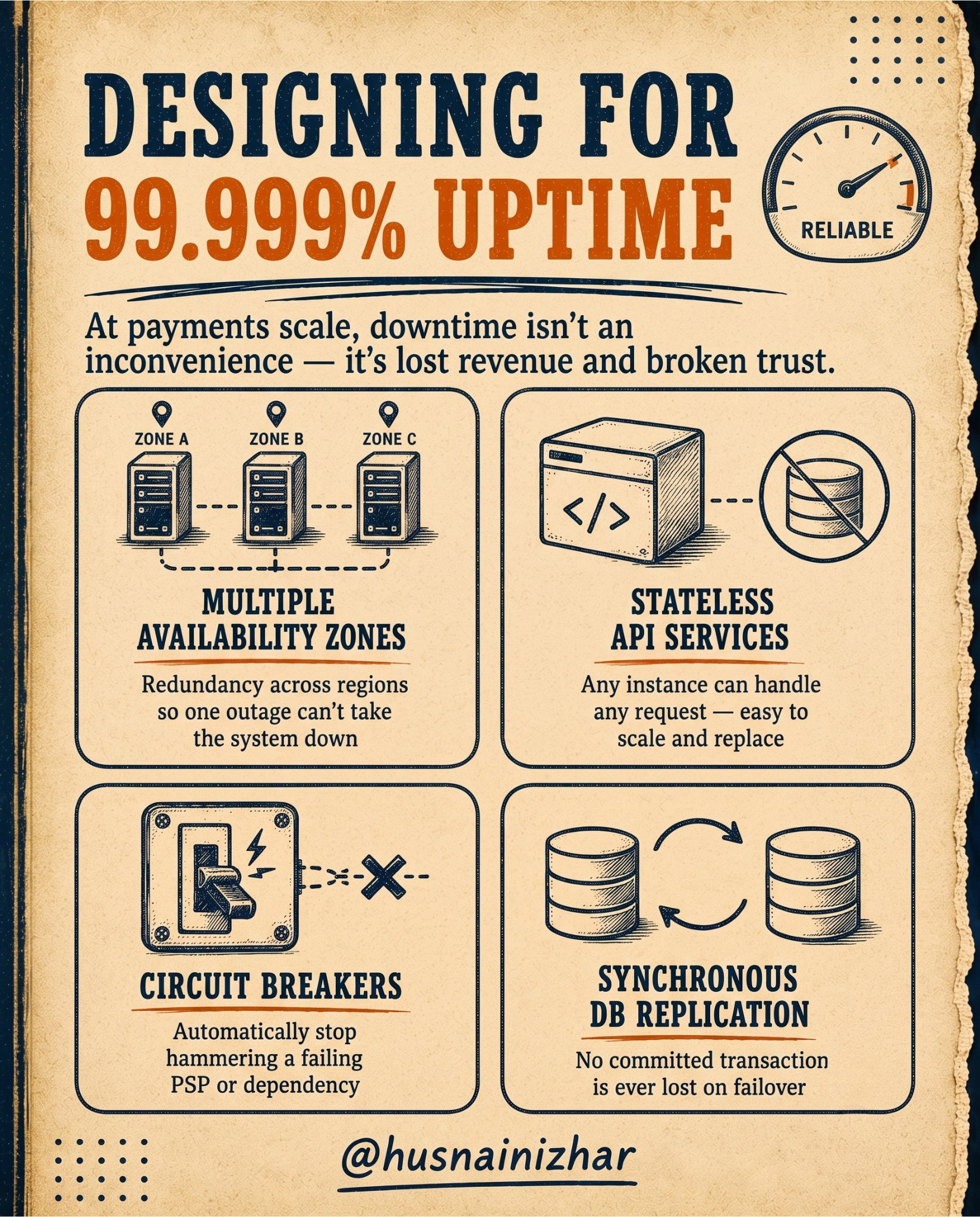
At payments scale, downtime isn't an inconvenience — it's lost revenue and broken trust. That reliability comes from a handful of infrastructure patterns working together:
- Multiple availability zones — redundancy across regions, so a single outage can't take the whole system down.
- Stateless API services — any instance can handle any request, which makes scaling and replacing instances trivial.
- Circuit breakers — automatically stop hammering a failing PSP or dependency instead of making the problem worse.
- Synchronous DB replication — ensures no committed transaction is ever lost on failover.
The Senior Engineer's Mindset
If you take one principle away from all of this, let it be this: in payments, correctness beats speed, every time.
A dropped request is annoying — the system retries, and life goes on. A duplicate charge is a trust-breaking, legal problem that no amount of speed was worth causing.
Building a payment system isn't about moving money fast. It's about moving it exactly once, recording it perfectly, and never making the user pay for a failure that was your infrastructure's fault to begin with.
Building or reviewing a payment system? These principles — phased processing, layered idempotency, immutable ledgers, and exactly-once state transitions — are the difference between a system that merely works and one that survives production.